|
|
Data
Management Association |
||||||
|
|
For Speaker List and Biographies, see Resources.
The past events are listed in reverse chronological order. If you are not sure when a given topic was presented,
enter the topic as a search string in the Google Search in the menu bar above.
November 8, 2011: Data Governance
September 19, 2011: DAMA Day
May 10, 2011: Data Governance
March 8, 2011: Cloud Computing, BioInformatics
November 9, 2010: Data Explosion, Predictive Analytics
May 11, 2010: Data Integration
March 9, 2010: Data Quality
January 12, 2010: Visualizing Data Architecture
November 10, 2009: Visualizing Data Architecture
September 15, 2009: Value Driven Enterprise Architecture
May 12, 2009: NEIM, Data Warehousing, and Introduction of Data Management Best Practices
March 10, 2009: Regular Meeting on Data Quality
January 13, 2009: Regular Meeting on Data Security Management
November 3-7, 2008: Data Management Virtual Symposium
September 9, 2008: Regular Meeting on Converting Logical to Physical Data Model, Panel Discussion
May 13, 2008: Regular Meeting on Data Architecture, Analysis & Design and Election of Board Members
March 11, 2008: Regular Meeting on Data Governance
January 8, 2008: Regular Meeting
November 5, 2007: Special Event on Master Data Management, Data Quality, and more
September 11, 2007: Regular Meeting and Election of Board Members
June 12, 2007: Regular Meeting
March 13, 2007: Regular Meeting
January 9, 2007: Regular Meeting
November 14, 2006: Regular Meeting
September 12, 2006: Regular Meeting
May 9, 2006: Regular Meeting
March 7, 2006: Regular Meeting
February 15, 2006: Special Class: XML in Data Management - 8:30 am to 5pm
January 10, 2006: Regular Meeting
November 8, 2005: Regular Meeting (8:30 a.m. at BLS)
November 8, 2005: ICCP Exam in Data Administration (afternoon at BLS)
November 8, 2005: Federal Metadata Management Coalition (FMMC) (1:00 p.m. at BLS)
September 21, 2005: Regular Meeting
June 8, 2005: Special 1 Day Tutorial: Data Modeling 101
May 10, 2005: Regular Meeting
March 8, 2005: Regular Meeting
February 14, 2005: Special 1 Day Seminar: DoD Enterprise Architecture
January 11, 2005: Regular Meeting
November 9, 2004: No Meeting (replaced by Metatopia 2004)
November 4 & 5, 2004: Metatopia 2004 - DAMA-NCR annual conference
September 14, 2004: Regular Meeting
June 4, 2004: Special Seminar with Fabian Pascal
May 11, 2004 (morning): Regular Meeting
May 2 - 6, 2004: DAMA International Symposium (Trip Report for DAMA-I 2004 Symposium)
March 9, 2004: Regular Meeting
January 13, 2004: Regular Meeting
November 12, 2003: Regular Meeting
September 29 & 30, 2003: Metatopia 2003
May 13, 2003: Regular Meeting
May 14, 2003: Special Seminar
April 27 - May 1, 2003: 15th Annual DAMA International Symposium &
7th Annual Metadata Conference 2003 at Orlando, FL
March 11, 2003: Regular Meeting
January 14, 2003: Regular Meeting
November 12, 2002: Regular Meeting
October 24, 2002: Special Meeting
September 10, 2002: Regular Meeting
May 14, 2002: Regular Meeting
April 28 - May 2, 2002: 14th Annual DAMA International Symposium & 6th Annual Meta-Data Conference (San Antonio, TX) - 20 page summary, pictures and more are available (see below).
March 12, 2002: Regular Meeting (note venue is back at BLS)
January 8, 2002: Regular Meeting: note change of venue!
November 27 ¿ 30, 2001: ER2001 Workshop (Yokohama)
November 13, 2001: Regular Meeting: note change of venue!
October 29 - 31, 2001: DAMA International Europe 2001 Conference (London)
October 17-19, 2001: DAMA Australia Conference (Canberra)
September 20-21, 2001: Metatopia 2001: a symposium on metadata and data management.
September 11, 2001: Regular Meeting
May 9, 2001: Special Seminar: Practical Issues in Database Management
May 8, 2001: Regular Meeting
March 23, 2001: Data Warehouse Conference 2001
March 4 - 8, 2001: DAMA International 2001 Symposium
March 13, 2001: Regular Meeting
February 12, 2001: One day Seminar on E-Business: What are the Real Data Issues ?
January 9, 2001: Regular Meeting
November 14, 2000: Regular Meeting
Oct 30, 2000: Hands On Data Modeling Workshop
September 12, 2000: Regular Meeting
May 9, 2000: Regular Meeting
March 19-23, 2000: DAMA International Symposium and Metadata Conference at Washington, DC
March 14, 2000: Regular Meeting
January 12, 2000: Regular Meeting (the normal date was changed to accomodate a special speaker from Australia)
December 6, 1999: SPECIAL EVENT: Data Modeling 101
November 9, 1999: Regular Meeting
October 12, 1999 - Special Event - Ron Ross on Business Rules
October 1, 1999 - DATA WAREHOUSE AND DATA MINING CONFERENCE (with DAMANE)
September 14, 1999: Regular Meeting (first regular meeting of 1999/2000 program year) Topic: Data Quality
August 2, 1999: Data Modeling 101 - full day tutorial
May 25, 1999: HALF DAY SEMINAR - Validating Information Models
May 14, 1999: SOCIAL EVENT - Wine Tasting at the French Embassy
May 11, 1999: Regular Meeting
April 18-22, 1999: DAMA International Symposium and Metadata Conference
Chapter Meeting November 8, 2011
Two great speakers on the topic of Data Governance!
- Gwen Thomas, Founder and President of the Data Governance Institute, will speak on Data Governance.
- Norman Steele, Fannie Mae Enterprise Data Management will speak on the Synergy of Metadata and Data Governance.
Time Speaker
BiographiesPresentations 8:00 - 8:30 Registration & Opening Remarks 8:30 - 9:30 Seth Grimes Text, Content, and Social Analytics: BI for the New World 9:30 - 9:40 Break 9:40 - 10:40 Michael Simcock National Information Exchange Model (NIEM) and Enterprise Data Management 10:40 - 10:50 Break 10:50 - 12:20 Keynote: John Zachman THE ZACHMAN FRAMEWORK: INTRO TO SAMPLE “PRIMITIVE” MODELS 12:20 - 12:50 Pizza Lunch (provided) 12:50 - 13:20 Geoffrey Malafsky Eliminating Barriers to Agile BI using NoSQL Object Data Model Semantic Vocabulary 13:20 - 13:30 Break 13:30 - 14:30 Michele V Koch, Sallie Mae How to Design Your Data Governance Program - Our Experiences at Sallie Mae 14:30 - 14:40 Break 14:40 - 15:40 Micheline Casey Leveraging information for governmental transformation: the Colorado story 15:40 - 15:45 Closing Remarks
DAMA Day ProgramText, Content, and Social Analytics: BI for the New World
Seth Grimes - Alta Plana CorporationThe information technology Old World consists of fielded records in structured databases -- transactions, profiles, log files, and reference data. The New World is everything else, including online media and massive volumes of social postings and other forms of "user generated content." We want it all: The business insights and predictive power to be gained by analyzing and mining Old World data, augmented by quantitative and qualitative data newly discoverable in formerly inaccessible New World sources. It's text and content analytics -- technologies that extract the information content of textual and other "unstructured" sources -- coupled with network-analysis methods, that extend BI into new domains. Techniques include sentiment and influencer analysis, behavioral models, and psychometric profiling as well as more conventional "textual ETL." The net result is progress toward universal information access, a new BI.
Seth's talk will introduce the "unstructured information" challenge, the business and technical context and drivers that motivate us to collect and analyze online, social, and enterprise content as a complement to, and in conjuction with, our BI work. He will discuss text and content analytics technologies and how they mesh with larger social and enterprise analytics efforts. And he will provide guidance on moving your organization toward this vision of universal information access.
Leveraging information for governmental transformation: the Colorado story
Micheline Casey - advisor to the CIO of the Department of Education
The State of Colorado has produced a ground-breaking and progressive agenda for information sharing and information technology management.
The Governor's Office of Information Technology has focused on agile application and service delivery with a strong emphasis on data quality. The Colorado Data Strategy ensures that state government policy makers and knowledge workers have the data and information they need to do their work. The business-ization of government requires a disciplined approach to managing data and information resources.
Outcomes gained include:
- Dismantling data silos
- Implementing the necessary infrastructure to enable collaborative information sharing across agencies, branches, and levels of government
- Acquiring the necessary tools to build capacity for knowledge and performance management going forward.
Ms. Casey will present an overview of Colorado’s Data Strategy and how they are building a Data Governance Program from the ground up.
National Information Exchange Model (NIEM) and Enterprise Data Management
Mike Simcock - DHS Data Management Working GroupIn the first half of 2010, the White House Office of Management & Budget directed the CFO Act agencies to evaluate the use of NIEM for information exchange across government missions. To support all of the Federal agencies in advancing data architecture by building NIEM into their enterprise data management initiatives, DHS developed a briefing with successes, core lessons learned, data strategies, performance metrics, operational guidelines, and more. This briefing has been briefed to chief architects and chief data architects across the Federal departments and agencies and continues to be requested by data leads throughout the government. NIEM and EDM have also helped to drive open government and transparency initiatives such as Data.gov. DHS continues to provide leadership and support to continuing development of the FEA Data Reference Model and improvements with implementation lessons learned and best practices.
THE ZACHMAN FRAMEWORK: INTRO TO SAMPLE “PRIMITIVE” MODELS
John A. ZachmanFor many years, I have argued that engineering an Enterprise is far different from building and running systems. Engineering an Enterprise requires single variable, “primitive” models, whereas building and running systems requires multiple variable, “composite” models. If you want the Enterprise to be “architected”, then the “composite” implementation (systems) models must be created from components of “primitive” engineering (architecture) models. If the “composite” implementation models are created before any “primitive” models exist, then the Enterprise will be implemented (running systems), but NOT “architected.”
The problem is, for the last 60 or 70 years, those of us who come from the information community have been solely focused on building and running systems (implementations) not on engineering Enterprises (architecture). We build and use “composite” models. We don’t relate to “primitive” models because we don’t build or use “primitive” models. This presentation argues the utility and necessity of Primitive Models for Enterprise Architecture by way of introducing the Sample Primitive Models.
How to Design Your Data Governance Program - Our Experiences at Sallie Mae
Michele Koch – Director of Enterprise Data Management and the Data Governance Office at Sallie MaeIn this presentation, learn how Sallie Mae, the winner of the 2011 Data Governance Best Practice Award, deployed a strong Data Governance (DG) Program to solve enterprise boundary-spanning data issues by pulling together the pieces of the data puzzle.
Attendees will learn:
- The “non-traditional” Data Governance framework Sallie Mae used and the benefits of that approach
- How the DG Program contributed to the success of Sallie Mae during tumultuous industry changes
- The key critical success factors and lessons learned
Eliminating barriers to Agile BI using NoSQL object data model semantic vocabulary
Geoffrey Malafsky – CEO, Phasic Systems, IncDataStar™ Agile BI streamlines barriers to common, meaningful, corporate data shortening timelines 10x. DataStar Discovery accelerates defining business requirements, data architecture, system functions, and governance products into common business understanding and terminology definitions (ontologies), dimensional/relational data models, NoSQL object data model with semantic vocabulary, business rules in standard English, master codes, XML metadata schema, and more. DataStar Unifier integrates disparate data using NoSQL object data model semantic vocabulary, and performs analytics on unified data via templates.
Semantic conflicts, lengthy data element mapping, and datacubes are eliminated. Source data (relational, XML, flat) is automatically integrated, transformed, and value checked.
1:00 - 1:30 1:30 - 3:00 Architecting Cloud Computing: A Data Driven Approach by Dr Daniel Spar
Cloud computing includes a broad collection of services, ranging from business processes to infrastructure, but the viability of it as part of a highly reliable, secure environment is still not clear. Additionally, much of the attention on cloud is technology focused vs. business-driven.
This presentation will present a structured overview of the current state and future direction of the cloud environment, and synthesize the theory, practice, direction and associated technologies of cloud computing. This presentation will illustrate how the cloud can be modeled in enterprise architectures to analyze and enable specific capabilities, and how business strategy and operating models can be designed to leverage the cloud. Particular emphasis will be placed on the data-driven artifacts.
3:00 – 3:15 Break 3:15 – 4:15 Gene Logic's Expression Databases by Dr Philip Musk and Dr Norrie Russell
Dr Philip Musk is Product Development Director for Gene Logic. His role is to manage the development and commercialization of the Gene Logic’s AscentaTM product line. This is a tool for comparing gene expression patterns between normal and diseased human tissues. This tool accesses our BioExpressTM reference database of many 100’s of millions of data points characterizing the expression levels of all 30,000 human genes in over 22,000 human tissue samples in multiple disease areas. The database construction and data management challenges will be addressed. Dr Norrie Russell is the President of Gene Logic and he will address some of the interpretation challenges and the contribution of this dataset to the discovery of biomarkers in the era of personalized medicine.
4:15-4:30 Wrap-up
Chapter Meeting January 11, 2011 Meeting was cancelled due to inclement weather and speaker cancellations
Chapter Meeting November 9, 2010
1:00 - 1:30 Registration & Networking 1:30 - 3:00 Managing the Explosion of Data– Mark Guiton, Director, Government Relations, Cray Inc.
The proliferation of public and private data, which approaches the rate of 15Peta Bytes of new information/day, causes serious issues long term for IT Professionals. By the beginning of 2011, the amount of digital information will grow to over 1000 Exabyte’s .
In addition, sensor (Instrument) Proliferation creates more and more silos of data, faster and with more expectations, plus the complexity explosion increases exponentially. Mr. Guiton will discuss how to deal with this explosion using Semantic Data Bases to solve the problem of connecting the dots and managing the explosion of data.
- 80% of new data growth is unstructured. The majority of data is residing in e-mails, memos, notes from call centers and support operations, news, user groups, chats, reports, letters, white papers, marketing material, research, presentations , and Web pages
- 85 % of all business information exists as unstructured data (Merrill Lynch)
- White-collar workers will spend from 30% to 40% of their time this year managing documents (Gartner)
- The average company with 1K employees spends $5.3M yr finding information on its servers. 42% of managers use the wrong info at least once per week.
Mark Guiton serves as Director, Government Relations, responsible for working with federal executive and legislative branch officials on a variety of program, policy and procurement issues as it relates to advanced computing. Prior to joining Cray, Mr. Guiton served as legislative director in the U.S. Congress from 1999 to 2003 with a focus on appropriations and technology matters. From 1995 to 1998, he served as a technology policy advisor working closely with the House Government Management, Information and Technology subcommittee from 1995 to 1998. Before working in Congress, he was a computer programmer/analyst for Shared Medical Systems Corporation (now Siemens). Mr. Guiton received a B.S. in computer science with a concentration in electrical engineering from the University of Scranton, Pennsylvania.3:00 – 3:15 Break 3:15 – 4:15 Predictive Analytics and their role in reducing Waste, Fraud and Abuse - Dave Vennergrund
Mr. Vennergrund, a noted Waste, Fraud and Abuse expert, will discuss the use of data mining, predictive analytics, business intelligence and business analytics to detect and deter fraud across numerous federal clients.
David A. Vennergrund practice focuses on predictive analytics, fraud detection, and business intelligence. Dave has over 25 years of IT management, development, and research experience. He is responsible for the development and execution of data mining and warehousing business. The BI Center had more than a dozen projects and staff trained in business intelligence, data warehousing, and data mining tools. His clients included USDA, CDC, CMS, NIH, DARPA, DoD, Intelligence Community, US AID, US Courts, EPA, and IRS. architecture as a critical information asset base, whereby information/data is made useful, usable, and actionable by the organization.
4:15-4:30 Wrap-up
ICCP BETA TEST REMINDER
Loretta Mahon Smith is the exam coordinator for testing at the DAMA-NCR Chapter meeting. Please contact loretta@dama-ncr.com to confirm you will be taking ICCP certification examinations by close of business on Friday 2/26 to ensure that enough examinations are requested and delivered in time for the March 9th testing date. Loretta will send the final request to ICCP on that Friday evening.
1:00 - 1:30 DAMA National Capital Region Annual Business Meeting
DAMA-NCR will be having a general membership meeting. Business will include
All individuals interested in contributing their time to DAMA-NCR are welcome contact Loretta Mahon Smith, Loretta@dama-ncr.org for further information.
- Elections for open board positions
- Information from the EDW conference
- Raffe for copies of Business Rule Concepts by Ron Ross and Data Modeling Essentials by Graeme Simsion as well as Numerati by Stephen Baker.
1:30 - 2:45 Trends in Data Integration - Dave Nahmias
Data performance problems occur within even the most carefully planned and well executed data integration environments. Large and growing data sets combined with shortened operational timeframes often create unacceptable bottlenecks and latencies in processing and accessing data. The business ramifications of these data bottlenecks can be severe, resulting in lost revenue opportunities, increased costs, impaired decision making, and customer attrition.
A lack of understanding of the characteristics of data performance problems and of the advantages and disadvantages of various solutions can lead to approaches that are neither cost-effective nor scalable. Some of the most common approaches companies take to address data performance problems include:
All three of the above are suboptimal. For organizations experiencing these data performance problems, it is crucial to minimize or eliminate them before they impact the business. Ideally, the solutions will be implemented in such a way that they are cost-effective, do not require significant investments in additional software and hardware, and are not disruptive to the company’s existing, core data integration environment. We’ll discuss an alternative path and specific cases where organizations dramatically improve performance and reduce their overall cost structure.
- More software licenses
- More hardware resources
- Custom coded solutions
2:45 - 3:00 Break 3:00 - 4:15 SyncSort Product Demonstration
Syncsort is a global software company that speeds data processing, data integration, and data protection & recovery. They will walk through their sort, integration and protection products.
4:15 - 4:30 Wrap-up
ICCP BETA TEST REMINDER
Loretta Mahon Smith is the exam coordinator for testing at the DAMA-NCR Chapter meeting. Please contact loretta@dama-ncr.com to confirm you will be taking ICCP certification examinations by close of business on Friday 2/26 to ensure that enough examinations are requested and delivered in time for the March 9th testing date. Loretta will send the final request to ICCP on that Friday evening.
1:00 - 1:30 Registration & Networking 1:30 - 3:00 On the Authoritative Data Sources: One Data Element at a Time - Richard Wang, Ph.D., MIT, and Applications- Dr. Kelvin Huang

Richard Y. Wang is Deputy Chief Data Officer and Chief Data Quality Officer of the U.S. Army, CIO/G-6. He is currently on leave from the Massachusetts Institute of Technology where he directs the MIT Information Quality (MITIQ) Program. He also holds an appointment as University Professor of Information Quality, University of Arkansas at Little Rock. Before heading the MITIQ program Dr. Wang served as a professor at MIT for a decade. He received a Ph.D. in Information Technology from MIT.
Dr. Wang is the recipient of the 2005 DAMA International Achievement Award. Previous recipients of this award include Codd for inventing the Relational Data model, Chen for the Entity Relationship model, and Inman for data warehousing.
As the leader in the data quality field, Dr. Wang has extensive interactions with industry and government, serving as an expert consultant, principal investigator, and advisor to execute enterprise data quality, data warehousing, and data governance projects.
Dr. Huang is the President of Taskco Corporation, Adjunct Professor on Medical Informatics at Fordham University and Research Affiliate of the MIT Information Quality Program.
He is co-author of “Quality Information and Knowledge” (Prentice Hall, 1999), which emphasized the importance of quality information in knowledge discovery. Huang’s current research focuses on extending information quality and knowledge discovery to enterprise issues such as architecture, governance, risk management and data sharing. Additionally, he heads two clinical data repository projects on patient safety surveillance for acute-care and chronic-care environment.
Dr. Huang has been instrumental in the establishment of the knowledge management and asset reuse at IBM Global Services, transforming the IBM service business model. He also led the effort of IBM e-Commerce implementation and IBM Knowledge Management transformation. Prior to join Taskco, Dr. Huang was Vice President at IBM, Senior Consultant at the National Library of Medicine/National Institute of Health, Regional Director of Open Software Foundation, Asia Pacific and President of SingaLab (a JV of IBM and the Singapore government).
Dr. Huang earned his PhD in Electrical Engineering and Computer Science at MIT and MS in Mathematics at University of Illinois, Urbana-Champaign. Huang has won numerous awards, including the IBM Corporate Excellence Award, Gold Medal of Giga Information Award, and NLM Excellence Award.
3:00 - 3:15 Break 3:15 - 4:15 Overview of The DAMA Guide to the Data Management Body of Knowledge (DAMA-DMBOK) & CDMP Certification Process - Loretta Mahon Smith, President DAMA-NCR, AVP T Rowe Price
Version 1 of the DAMA-DMBOK Guide became available in April 2009, after three years of planning and collaborative development by DAMA members worldwide. The DAMA-DMBOK Guide provides a “definition introduction” to data management concepts, principles and practices. In this session, Loretta Smith, who participated in the development effort, will give a background to the project, and then preview the key concepts and diagram covering the essential ideas about each of the 10 data management functions and discussing editorial decisions and feedback received through the review process. This will be followed by briefly showing the contents of the BOK. Next she will provide brief overview of the process that a professional can go through for certification in the practice of Data Management which is now being updated and revised to leverage the DAMA-DMBOK.
4:15 - 4:30 Wrap-up
Chapter Meeting January 12, 2010
12:30-1:00 Registration & Networking 1:00-2:15 Google and Data Management - John Kaden, Federal Civilian Sales Executive, Google
Google has been identified multiple times as Fortune Magazine's #1 Best Place to Work, and is the most powerful brand in the world relating to search. The company is running thousands of servers worldwide, which process millions of search requests each day and about 1 petabyte of user-generated data every hour. Google is the most visited spot on the internet and its mission is “to organize the world's information and make it universally accessible and useful". This presentation will provide insight into what one of the most innovative firms in the world is doing when it comes to organizing information.
2:15- 2:30 Break 2:30-3:45 Apple and Data Management - Andy Kemp, Apple
Apple Inc. is one of the most innovative firms in the world – redefining the computer industry with the Macintosh and the music industry with iTunes and the IPOD. DAMA is very fortunate to have Apple present their solutions in the data management area to our local chapter. Apple was recently named the most admired company in the US in 2008 and the most admired company in the world in 2009. Apple will present their views on data management and what to expect from their solutions folks.
4:15-4:30 Wrap-up
Chapter Meeting November 10, 2009
1:00-1:30 Registration & Networking 1:30-2:45 Visualizing Data Architectures by Dave Levinson - AKA Dave Surface, CEO of Cranial Tap
Dave is a veteran online entertainment and video game professional with twenty years of experience producing compelling products with Sega of Japan, Time Warner Cable, Lockheed Martin, America Online, Intel and General Electric. Responsible for the launch of nearly 100 consumer products including video games, VoIP dashboards, social/community networks, switched circuit phone applications, user interfaces, interactive television experiences and presence applications. Dave is a published author, artist, inventor, strategist and visionary. He is the author of six filed patents in the virtual world space. He is the inventor of the wildly successful AOL SuperBuddy 3D characters and several other online consumer products and services.
A worldwide revolution is underway in business communications, research, collaboration, and training. Online 3D virtual worlds allow your firm to be more productive, bring global associates together, and reduce costs. This discussion will focus on how forward thinking firms are incorporating visualization into their data management efforts.
3:00-4:15 Matt Gallagher – Troux Technologies, Leading Enterprise Architecture Platform Demonstration
Troux Transformation Platform manages the full data-management lifecycle, including automated collection from multiple digital sources (CMDB, PPM, modeling tools, ERP systems, etc.) and human surveys with e-mail management and Web-based interfaces. Advanced relationship mapping, integrity checking, validation and authorization ensure that information is correct and up-to-date. Also includes visibility and deep analytics, as well as architecture governance, management and visual modeling.
4:15-4:30 Wrap-up
Chapter Meeting September 15, 2009
1:00-1:30 General DAMA Topics 1:30-2:45 Value Driven Enterprise Architecture - Aileen Morse, Chief Enterprise Architect, World Bank
Enterprise architecture is evolving beyond the IT realm and into an area that guides any organization at a more strategic business level. The session will discuss the evolution of enterprise architecture practices and a case study of how the discipline is being used to solve concrete business problems at the World Bank.3:00-4:15 Managing Data Growth and Data Privacy - Brent Janorske, IBM
Today’s economy is calling for cost reduction and improved efficiencies across the entire enterprise – to “do more with less.” Organizations are looking to maximize the business value of their existing IT infrastructure while at the same time control costs. Learn how effective Data Management strategies can help reduce costs, improve application performance and help protect your company from a data breach, all while increasing IT efficiencies. IBM Optim™ is an enterprise data management solution that addresses critical business issues, such as data growth management, data privacy compliance, test data management, e-discovery, application upgrades, migrations and retirements. During this session you will discover how to: manage data growth, protect data privacy, streamline test data management, and facilitate application retirement.
4:15-4:30 Wrap-up
Following our program schedule, the theme for this meeting will be Data Warehousing.
12:30-1:00 Registration & Networking 1:00-2:30 The State of Data Warehousing and the Impact of National Information Exchange Model (NIEM) - Jerry Dunaway, ASG Software Solutions
2:30- 3:00 Break & Annual Membership Election 3:00-4:45 The DAMA Guide to the Data Management Body of Knowledge (DAMA-DMBOK) Status Report - Loretta Mahon Smith, DAMA International
4:15-4:30 Wrap-up
Chapter Meeting March 10, 2009
Following our program schedule, the theme for this meeting will be Data Quality.
To Register:
- All attendees must register in advance.
- Please provide your name, organization, and phone number where you can be reached.
- Email the above information to loretta@dama-ncr.org.
12:30-1:00 Registration & Networking 1:00-1:15 Welcome & Business Meeting 1:15 2:30 Data Quality: A Success Factor
Practicioners: Alan Harmon, US Naval Academy, and Edith Purdie, EDP EnterprisesData quality can mean the difference between success and failure. Quality, although a key component in Data Governance and Master Data Management, is often included as a token effort or as an afterthought. This presentation will focus on an “inside-out”, holistic approach with emphasis on best practices and lessons learned.
2:30-2:45 Break 2:45-4:15 Data Quality Enterprise Risk Management: Operational Risks Beyond Security
By Todd Breinich, www.infogix.com4:15-4:45 Collaborative Disciple: International Association for Information and Data Quality (IAIDQ) 4:45-5:00 Wrap-up Meeting Location:
Bureau of Labor Statistics (see Directions and Security Procedures)
Conference Training Center - Ground Floor (under "1st floor")
Postal Square Building
2 Massachusetts Ave., N.E.
Washington, DC 20212
Chapter Meeting January 13, 2009
Following our program schedule, the theme for this meeting will be Data Security Management.
To Register:
- All attendees must register in advance.
- Please provide your name, organization, and phone number where you can be reached.
- Email the above information to loretta@dama-ncr.org.
12:30-1:00 Registration & Networking 1:00 -1:15 Welcome & Business Meeting 1:15 2:30 Managing Enterprise Risk: Building a Comprehensive Information Security Program, By Dr. Ron Ross, NIST csrc.nist.gov/staff/rolodex/ross_ron.html 2:30-2:45 Break 2:45-4:15 Vendor presentation by EMC: Information Security Policy Development: Authentication: Beyond Passwords, By Tommy Ward, Senior Manager, EMC Information Security Consulting 4:15-4:45 Complimentary Discipline Overview of Information Systems Security Association, by Steve Rodrigo of www.tenacitysolutions.net. Visit the Northern Virginia Chapter's website at ISSA-NOVA.org 4:45-5:00 Wrap-up Meeting Location:
Bureau of Labor Statistics (see Directions and Security Procedures)
Conference Training Center - Ground Floor (under "1st floor")
Postal Square Building
2 Massachusetts Ave., N.E.
Washington, DC 20212Additional Request
The March meeting on Data Quality Management was scheduled for a location in Baltimore that is no longer available. If any of the northern members of the chapter would be able to host that chapter meeting please contact the VP of Programs, loretta@dama-ncr.org.
Data Management Virtual Symposium November 3-7, 2008
The 2008 DAMA-NCR/Wilshire Virtual Symposium is a conference about enterprise information and data management which was delivered entirely in a webcast format. The conference is hosted by the National Capital Region Chapter of the Data Management Association (DAMA-NCR) and Wilshire Conferences.
The "virtual conference" is a concentrated series of webcast presentations which were scheduled live each day during the week of November 3-7, 2008. More than 700 participants from around the world attended the live conference. You can now download the archived sessions by following the instructions above.
The theme of this conference is “Leveraging Information Asset Management.”
The fee for attending the Symposium (either live or recorded) is $95. Discounts are available to DAMA members and some other affiliate groups; contact DAMA-NCR Chapter for discount information. All registrants are entitled to attend the entire 20 presentations (live or recorded).
Please be aware that all conference audio will be provided over the internet, so you will need a computer with audio output (ie. speakers or headphones) to hear the presentations.
We cover topics of interest to both private industry and government organizations at a variety of audience levels including business executive, entry level practitioner, and advanced practitioner.
Click the full conference agenda to see the entire program. Questions may be addressed to info@wilshireconferences.com.
Chapter Meeting September 9, 2008
Chapter Meeting September 9, 2008 Free to Members!
This meeting qualifies as 4 hours toward recertification for CCP, CDMP and CBIP certifications.This meeting will include three presentations
- “Converting from Logical to Physical: Discussion of the Issues” by Manan Shah
This presentation will look at the transition going from a logical model to a physical model, but also placing some emphasis on how to keep everything synchronized on both sides with the CA tool ERwin. New release features will also be covered.- Data Management Professional Collaboration Panel:
- National Capitol Region Oracle Users Group
- Baltimore Washington DB2 Users Group
- DAMA-NCR
- DAMA-DMBOK & Wilshire DAMA-NCR Conference Progress Reports by Loretta Mahon Smith
Meeting Location:
Please note that there is a LIMIT OF 40 attendees to this location and it will be first-come, first serve.
Bureau of Labor Statistics
Conference Training Center - Ground Floor (under "1st floor")
Postal Square Building
2 Massachusetts Ave., N.E.
Washington, DC 20212
This meeting qualifies as 4 hours toward recertification for CCP, CDMP and CBIP certifications.
Chapter Meeting May 13, 2008 .
Meeting Location:
Bureau of Labor Statistics
Conference Training Center - Ground Floor (under "1st floor")
Postal Square Building
2 Massachusetts Ave., N.E.
Washington, DC 20212Agenda:
The focus for this chapter meeting will be the DAMA-DMBOK area of practice, Data Architecture, Analysis & Design providing attendees an overview of the area of practice as well as an example of information related deliverables in their data architecture. The final speaker, from a complimentary discipline, will talk about the Business Analyst professional organization.Additionally, we will be holding elections for two board member positions. Participating on the board level of this chapter offers a data management professional the opportunity to both help their chosen profession, gain leadership experience, and have a high-profile association with one of the oldest and most respected DAMA chapters in the United States. Please review the job descriptions and consider nominating a colleague or yourself for a position!
12:30-1:00 Registration & Networking 1:00 -1:15 Welcome & Business Meeting: Officer Elections
- VP of Membership
- VP of Publicity
1:15 – 2:45 Overview of Data Architecture
Anne Marie Smith, PhD.
EW Solutions, Inc.
AMSmith@ewsolutions.com
2:45 – 3:00 Break 3:00 – 4:15 User-Centric Enterprise Architecture
Andy Blumenthal, Director of Enterprise Architecture and Governance,
United States Coast Guard
4:15-4:45 The International Institute of Business Analysts
Ray Siguenza, President IIBA-DC Chapter4:45-5:00 Wrap-up Topic 1: Overview of Data Architecture
Speaker 1: Anne Marie Smith - EWSolutions (see her bio)
Data Architecture is the design of data for use in defining the target state and the subsequent planning needed to hit the target state. Data Architecture is one of the pillars of Enterprise Architecture and should be aligned with the pillars of Business Architecture, Application Architecture and Integration Architecture. This overview presentation will explain Data Architecture, describes how data is processed, stored, and utilized in a given system. This presentation will demonstrate that data architecture provides criteria for data processing operations that make it possible to design data flows and also control the flow of data in the system. An overview of the role of a data architect and the importance of meta data management and data governance will also be included.
Topic 2: User-Centric Enterprise Architecture
Speaker 2: Andy Blumenthal (see his bio)
Andy will discuss how the Coast Guard uses enterprise architecture as a critical information asset base, whereby information/data is made useful, usable, and actionable by the organization.
March 11, 2008: Chapter Meeting
Please note that there is a LIMIT OF 50 attendees to this location.
- No Data Left Behind: An Enterprise Data Management Case Study
- Protecting Your Company and Your Customers: Understanding Information Governance
- Governance, Control, Security and Audit Professionals Association Representative
Fee: Free to members, $30 for non-members (see membership fees and benefits)
Location: T Rowe Price, Baltimore (see Directions and Security Procedures)To Register:
- All attendees must register in advance.
- Please provide your name, organization, email address, and phone number where you can be reached.
- Email the above information to register@dama-ncr.org
Agenda:
12:30 - 1:00 p.m - Sign In 1:00 - 1:15 p.m - Introduction - Data Governance 1:15 - 2:45 - Practitioners: No Data Left Behind: An Enterprise Data Management Case Study Holly Hyland, Lisa Elliott, Barbara Timm 2:45 - 3:00 - Break 3:00 - 4:30 - Subject Matter Expert/Vendor: Protecting Your Company and Your Customers: Understanding Information Governance Princeton Softtech 4:30 - 5:30 - Complimentary Discipline: Governance, Control, Security and Audit Professionals Association Representative Linda Kostic
isaca-washdc.org/5:30 - ??? - Happy Hour and Networking Event, Location TBD
Topic 1: No Data Left Behind: An Enterprise Data Management Case Study
Speaker 1: Holly Hyland, Lisa Elliott, Barbara Timm
Topic 2: Protecting Your Company and Your Customers: Understanding Information Governance
Speaker 2: Princeton Softtech
Topic 3: Governance, Control, Security and Audit Professionals Association Representative
Speaker 3: ISACA Representative Linda Kostic
January 8, 2008: Chapter Meeting
This meeting qualifies as 4 hours toward recertification for CCP, CDMP and CBIP certifications. It will include three presentations:
Please note that there is a LIMIT OF 40 attendees to this location.
- Applying Semantic Web Technologies toward a Net-Centric Data Strategy” by Matt Fisher
- Breaking the Data Bottleneck to Achieve SOA Objectives by Greg Palmer
- Data Management Certification Process by Loretta Mahon Smith
Fee: Free to members, $30 for non-members (see membership fees and benefits)
Location: BLS Conference Training Center (see Directions and Security Procedures)To Register:
- All attendees must register in advance.
- Please provide your name, organization, email address, and phone number where you can be reached.
- Email the above information to register@dama-ncr.org
or- Call DAMA-NCR at 202-465-4399 and leave a message (it will be forwarded to board members as an email attachment).
Agenda:
1:00 - 2:30 p.m - Speaker Matt Fischer 2:30 - 3:00 - Break 3:00 - 4:30 - Speaker Greg Palmer 4:45 - 5:00 - Information on ICCP testing by Loretta Smith
We have the ability to offer Data Management Professionals testing to receive their certifications from ICCP. This will be a brief discussion about the certification and testing process.5:00 - . - Closing 5:30 - ??? - Happy Hour and Networking Event, Location TBD
Topic 1: Applying Semantic Web Technologies toward a Net-Centric Data Strategy
Speaker 1: Matt Fischer
Abstract: One of the latest solutions for collecting information from disparate data sources involves federated semantic queries. They offer many advantages over traditional solutions, ranging from non-disruptive, virtual data aggregation to domain-specific query capabilities. This presentation describes a semantic query architecture which decomposes SPARQL queries based on OWL domain and data source ontologies, SWRL ontology translation rules, OWL-S service descriptions and database mappings, to support federated semantic queries across multiple relational databases, web services and/or SPARQL endpoints. The implementation of such an architecture in a net-centric data sharing environment, as specified in the DoDÍs 8320.02-G directive, will also be discussed.
Topic 2: Breaking the Data Bottleneck to Achieve SOA Objectives
Speaker 2: Greg Palmer
Abstract: Increasingly, organizations are discovering that a big bottleneck to achieving the promise of a Service Oriented Architecture (SOA) is how to properly integrate your data. Most new applications, SOA or not, utilize data from an existing systems foundation. This data is complex, diverse and spread across the enterprise in various technology and application silos. Each source has its own access mechanisms, syntax, security, etc., and few are structured properly for consumption, let alone reuse.
Learn how Data Services, a specialized form of Web Service optimized for the real-time time data integration demands of SOA, can help organizations overcome these bottlenecks.
November 5: Special Event on Master Data Management, Data Quality, and more!
Fee: Free to members, or with paid Metatopia registration
Non-members (see membership fees and benefits)
$90 to attend the full-day event, including all 6 speakers
$120 includes attendance at the event and 2 years DAMA-NCR membership, which includes free attendance at chapter meetingsLocation: BLS Conference Training Center (see Directions and Security Procedures)
To Register:
- All attendees must register in advance. Please note that there is a LIMIT OF 40 attendees to this location and it will be first-come, first serve.
- Please provide your name, organization, email address, and phone number where you can be reached.
- Email the above information to register@dama-ncr.org .
Agenda:
8:30 - 9:00 - Registration (breakfast goodies furnished by sponsor) 9:00 - 9:15 - Welcome 9:15 - 10:15 - Speaker David Hay, President Essential Strategies, Inc. 10:15 - 10:30 - Break 10:30 - 11:30 - Speaker David Loshin, President Knowledge Integrity, Inc. 11:30 - 1 p.m. - Lunch Join the speakers for lunch at America Restaurant in Union Station. (see Menu with prices.) 1:00 - 2:00 - Speaker David Webber, SOA Architect 2:00 - 2:15 - Break 2:15 - 3:15 - Speaker Bonnie O'Neil, Sr. Principal Data Architect
Yazmin Rowe, Data Architect4:00 - 5:00 - Speaker Suzanne Acar, Senior Information Architect, 5:00 - 5:15 - Closing 5:30 - ??? - Happy Hour Topic 1: Data Structure: Data Modeling or XML?
Speaker: David Hay, President Essential Strategies, Inc.
Abstract: XML was designed as a way to organize data for the purpose of transmitting data from one place to another. A relational databases is intended to be a way of organizing data for the purposes of storing and managing them. While both technologies are concerned with data structure, their purposes are clearly different, and confusing them (which is often done) is done at a companyÍs (or a government agencyÍs) peril.
This presentation will describe the history of data organization, from hierarchical to relational to hierarchical again. This presentation will present an example of the same domain presented as a data model (and its corresponding relational database design) and as an XML schema, showing the information lost in converting from one to the other.Topic 2: Principal MDM Components and Capabilities
Speaker: David Loshin, President Knowledge Integrity, Inc.
Abstract: The proliferation of enterprise-level application expectations for shared, synchronized information drives the need for the development of a single view of the key data entities in common use across the organization. At the technical level, the drivers and fundamentals of master data management (MDM) can be summarized as processes for consolidating variant versions of instances of core data objects distributed across the organization into a unique representation. In turn, that unique representation is continually synchronized across the enterprise application architecture to allow master data to be available as a shared resource. The result is a master repository of uniquely identified key data entity instances integrated through a service layer with the applications across the organization.
However, the devil is in the details. In order to accomplish what may seem to be a relatively straightforward set of ideas, the organization must be prepared for the technical, operational, and management challenges that will appear along the way. And in fact, the deployment of an MDM solution could evolve through a number of iterations, introducing data object consolidation for analytic purposes as an initial step, then following on with increasing levels of integration, service, and synchronization.
The end-state master data management environment exists as an enterprise resource integrated with the enterprise application architecture through a collection of provided services. This tutorial reviews the components and capabilities needed to develop an MDM solution that can mature along with the needs of the client enterprise applications with which it is integrated.Topic 3: SOA Data Integration - The Unsolved, Unspoken Problem
Speaker: David Webber, SOA Architect
Abstract: While SOA seeks to provide reusable agile services across enterprise systems little has been articulated on the challenges of information integration. How do implementers ensure that their information can be consumed, purposed and reused reliably and securely? We know from the prior ebXML, ISO 11179 and CEFACT work that role, context and common metadata and core component semantic definitions are vital to enable consistent information use. However XML and XSD schema use over the past ten years has not advanced past the capabilities of EDI systems in many respects and particularly in its abilities to support context, role and metadata core components. Coupled to this is the need to have support for business process models and definitions and the document handling across their workflow state transitions. All these are challenges to implementing agile information exchanges that implementers face today. The new OASIS CAM specification standard provides considerable new capabilities for information integration using familiar XML enabled techniques with XPath, XML DOM and xslt based handlers. CAM templates can be immediately created to speed adoption of common information formats, rules and contextual handling between participants and systems. These are vital to allow rapid SOA service integration and reuse. Techniques from CEFACT CCTS, CCMA and NDR can also be leveraged to create reusable and consistent subassembly components. This provides a much more agile and flexible information exchange model that can meet a variety of SOA needs based on the role and context of the service users. Unlike todays XSD based web services that are brittle, static and hard to document, CAM templates allow fault tolerant and adaptive content handling with multiple structures and instant documentation generation. This delivers key support for SOA services and their information exchanges own data services layer needs.In addition support for work on Genericode metadata for reference code lists from ISO and the UN is included in CAM templates so international standard code values can be incorporated and checked.
The available open source implementation of CAM (jCAM Æ http://www.jcam.org.uk) provides Eclipse editor tools and cross platform validation and handling runtime tools. It also supports generating interactive documentation (iDocs) from xslt scripts along with other exciting capabilities for exploiting the capabilities underpinning the OASIS CAM template formats. The presentation will include demonstration of simplifying and aligning complex interchange schemas such as UBL using the Eclipse Wizard tools and sample exchange XML transactions. Also generating iDocs and how these can be extended to collaborative metadata registry and wiki-based vocabulary uses. Existing developmental work and future directions will be discussed. Participants will take away a strong understanding of how they can quickly and easily leverage the CAM standard capabilities to enhance their own XML interchange needs. Sharing and building libraries of CAM templates in support of SOA initiatives will also be discussed and examples of UBL, PESC, EML and other XML standards domains provided.Topic 4: Data Quality: Prerequisite for Data Sharing
Speakers: Bonnie O'Neil, Project Performance Corporation
Yazmin Rowe, Technology In Motion, Inc.Abstract: At a government bureau focusing on Law Enforcement, data sharing is an imperative for the Bureau to accomplish its mission and to ferret out the “bad guys”. Other government agencies and even within the Bureau itself need the data created by the Bureau to fight crime together. However, the Bureau began to examine the data to figure out what it would share and discovered it wasn’t even sure what the data represented in certain circumstances, let alone if it was in good enough shape to share. Therefore, we embarked on a Data Quality initiative that was well-received. This presentation involves a Case Study about Data Quality and Data Sharing and will cover the following topics:
- Top Down/Bottom up Approach to Understanding Data
- The importance of definitions to Data Quality
- Involving business people and Data Stewardship
Topic 5: Federal Data Quality Profile: A Framework for Better Information Sharing
Speaker: Suzanne Acar, Senior Information Architect, Federal Data Architecture Sub-committee Co-chair
U.S. Department of the InteriorAbstract: As agencies migrate from a program-centric towards a citizen-centric environment where information is made easier to find, understand, and access, the quality of that information becomes imperative. Problems with data quality in a networked world can result in tangible and intangible damage ranging from loss of information consumer confidence to loss of life and mission.
Managing data quality is essential to mission success. It ensures that quality data supports effective decision-making and that data gets to the right person at the right time in the right way. Federal agencies and Communities of Interest often have a number of data quality disciplines at their disposal, but rarely will they implement all disciplines at once because improving data quality is a process and not an event.
The Federal Data Quality Profile is designed to provide the framework for consistent understanding and practices of data quality across agencies and Communities of Interest. It explains how systematic data quality improvement within federal agencies supports the objectives of the Federal Enterprise Architecture at every level, to facilitate better cross-agency collaboration. Suzanne Acar, Federal Data Architecture Subcommittee co-chair, will discuss government best practices for data quality and the intended outcomes of the Federal Data Quality Profile.
September 11: Regular Meeting and Election of Board Members
Geographic Information Services, Guest Speaker Michael Scofield of ESRI, Manager of Data Asset DevelopmentFee: free to members, $30 for non-members (see membership fees and benefits)
Location: BLS Conference Training Center (see Directions and Security Procedures)
To Register:
- All attendees must register in advance.
- Please provide your name, organization, email address, and phone number where you can be reached.
- Email the above information to register@dama-ncr.org
or- Call DAMA-NCR at 202-465-4399 and leave a message (it will be forwarded to board members as an email attachment).
Agenda:
8:30 - 9:00 a.m - Registration (breakfast goodies furnished by sponsor) 9:00 - 9:15 - Business Meeting, Election of Board Members
Nominee for President -> David Colpitts, Tom McCullough,
Nominee for Vice President of Program Planning -> Loretta Smith
Nominee for Vice President of Administration and Finance -> Paul Englehart9:15 - 11:30 - Speaker to be announced. 11:30 - Noon - Product demo by sponsor Noon - 1 p.m. - Lunch Join the speakers for lunch at America Restaurant in Union Station.
(see Menu with prices. Tax and tip will be paid by the meeting sponsor and DAMA-NCR.)1:30 - 4:30 - Workshop on Data Exchange Topic 1: Introduction to Geospatial Data Architecture and GIS Data Management
Speaker 1: Michael Scofield, Manager of Data Asset Development at ESRI, Redlands, CA (See his bio)
Abstract: Geographic information systems are a growing category of data assets. GIS is a collection of computer hardware, software, and geographic data for capturing, managing, analyzing, and displaying all forms of geographically referenced information. Data include traditional maps (albeit digitalized) and components of maps (“layers”) as well a variety of image types. All these can be integrated for creating unique displays and presentation as well as some very powerful analysis of issues which are geographically-dependent.
GIS databases pose unique challenges in data management because of their complexity and unique structural requirements. While a number of standard data models have been created for specific topics (such as census, water features, transportation, and utilities) not all the data available conforms to these models. And the very nature of geography on an imperfect and not quite spherical globe introduce new challenges to achieving accuracy in positional data.
GIS analysis offers great potential in evaluating non-geographic behavior characteristics of customers and corporate assets from a geographic perspective. This is much more than the traditional questions of optimum placement of retail establishments. It includes epidemiology and environmental studies. But integrating the data presents a major challenge.
Topic 2: Managing the Data Exchange Relationship
Speaker 2: Michael Scofield
Abstract: Any time data is exchanged between distinct and dissimilar organizations, a relationship exists with a variety of duties, expectations, and technical issues. This relationship must be managed.
When one party seeks to acquire data from another, there are a host of issues which must be addressed unambiguously. The acquisition of data (particularly from business production systems) usually places some kind of burden upon the data originator/supplier, both for initial extract, and recurring updates. Issues of architectural differences, architectural stability, scope, data quality, replication techniques, permissible usage, liabilities—all these must be addressed.
Of particular concern are incremental extractions of data after the first big bulk transfer. It is crucial to understand the difference between updates and corrections. It is also important, if the incremental transfers occur over a longer period of time, to detect changes in scope, architecture, meaning, and quality of the incremental updates.
Over 94 questions which you should ask about the data exchange are clustered into the following general topics:
- Kinds of data and information
- Data suitable for your needs
- Burden placed upon source organization
- Logical data architecture of source
- Physical format and media
- Data semantics and meaning
- Documentation and testing
- Scope
- Completeness
- Currency
- Versioning
- Quality
- Update/refresh/corrections
- Confidentiality
- Ownership and usage
- Purpose of original data collection and transfer
- Liability
Fee: free to members, $30 for non-members (see membership fees and benefits)
Location: Baltimore at St. Paul's Plaza building Conference Room 27E.
T. Rowe Price
200 St. Paul Plaza, Baltimore, Maryland
(410)345-2000From the north:
Take I-83 South (Jones Falls Expressway) directly into Baltimore City.
Exit at St. Paul Street South.
Follow St. Paul Street for many blocks, at the split, stay to the right.
The Tremont Hotel will be on the right at the top of a steep incline.
200 St. Paul Plaza is the next building on the right.
Turn right onto Lexington Street - the parking garage is the first entrance on the right.
Registration Procedure: Send email to register@dama-ncr.org and state the date of the meeting. Please provide name, organization, and phone number.
Please note that access to the meeting is via a secure elevator, and that our host, Lorraine Smith of T. Rowe Price will be arranging for our access to the meeting room.
Agenda:
| 8:30 | - | 9:00 a.m | - | Registration | |
| 9:00 | - | 9:15 | - | Business Meeting | |
| 9:15 | - | 11:00 | - | Peter
Aiken Topic: Overview: XML in Data Management |
|
| 11:15 | - | 1:00 p.m. | - | Anne Marie
Smith Topic: Master Data Management |
|
| 1:00 pm | . | - | Lunch
Join the speakers for lunch at Mick O'Shea's (see www.mickosheas.com for prices ) |
||
| After Lunch | - | Depending
on interest ICCP exams may be given after the lunch. Contact Loretta_Smith@troweprice.com to arrange a test seating. |
|||
Topic 1: Overview: XML in Data Management
Speaker 1: Dr. Peter Aiken (see his bio)
Abstract:
XML can be to data what Java is attempting to be to programming languages. Wrap an application?s data once with XML-based metadata and utilise it with any XML-enabled application! XML-based data integration will soon be the norm. In many cases XML permits a simple to use and inexpensive to implement yet more robust means of electronically exchanging data than ? electronic data interchange (EDI). Some say that XML is EDI for the rest of us! XML is sufficiently mature to have been architected into the core of Microsoft Office 2000. In Office, XML is used to represent the internal formats and styles used by the integrated applications. This permits versions of Office 2000 documents to be saved as html files and then subsequently reopened by office components without losing relevant formatting detail. More importantly, it represents one important new source of previously unstructured data that ? using XML ? data administrators can begin to incorporate into existing corporate data assets.
Topic 2:
Speaker 2: Anne Marie Smith, Ph.D. (See her bio)
Abstract:
Master data management (MDM) is the disciplined technique of managing process, technology and integration architectures related to acquisition, collation, mapping, cleansing, storing and publishing reference-oriented data required to create and maintain an enterprise-wide "single source of truth" for core business entities in order to capture transactions and measure results for these entities. The main steps for master data transformation are:
Consolidating information into a single master database,
Refining and enriching data centrally for distribution across an enterprise, and
Synchronizing data for a consistent enterprise view.
Effective data management process consists of four steps: domain analysis, data integrity assessment, data quality assessment and process orchestration. Unfortunately, many organizations struggle to reconcile master data from across the enterprise, particularly as it is duplicated and maintained in multiple systems.
This presentation will provide an overview of master data management (MDM), a set of principles to follow for successful development of a master data management approach, and outline the recommended processes used to create and maintain a master data management environment, and offer.
Presentation Outline:Introduction to Master Data Management
Master Data Management Across the Enterprise
Principles in Master Data Management Development
Best Practices and Recommended Approaches to MDM
Obstacles to Avoid in MDM
MDM and Information Management Professionals? Role
Conclusion and Questions and Answers
[top]
Fee: free to members, $30 for non-members (see membership fees and benefits)
Location: BLS Conference Training Center (see Directions and Security Procedures)
Agenda:
| 8:30 | - | 9:00 a.m | - | Registration (breakfast goodies furnished by sponsor) | |
| 9:00 | - | 9:15 | - | Business Meeting | |
| 9:15 | - | 11:30 | - | Lectures and discussions | |
| 11:30 | - | Noon | - | Product demo by sponsor | |
| Noon | - | 1 p.m. | - | Lunch Join the speakers
for lunch at America Restaurant in Union Station. (see Menu with prices. Tax and tip will be paid by the meeting sponsor and DAMA-NCR.) |
Topic 1: Leveraging your Embedded Metadata Download presentation
Speaker 1: David Beulke, President Pragmatic Solutions, Inc. (See his bio)
Abstract:
There is metadata everywhere and today's system can happily supply you with an abundant amount of information. Harvesting this data is very easy and this presentation will show you how to quickly and easily gather this information and build a metadata encyclopedia. This encyclopedia can provide an extensive data dictionary, help you track data quality and data lineage throughout your systems. This presentation will help you learn how you can build this information and help your business analysts and developers understand your system metadata better.
Topic 2: A Holistic Approach to Enterprise Data Management Download presentation
Speaker 2: Deborah Brooks, Principal Information Systems Engineer, The Mitre Corporation (See her bio)
From Wikipedia: (Enterprise Data Management) strategy and governance:
ñEDM (Enterprise Data Management) requires a strategic approach to choosing the right processes, technologies and governance. While traditionally thought of as a technology problem data/information can now be thought of as a business problem and as such can require a different range of techniques.î
From Wikipedia: Holistic:
ñHolism (from λος holos, a Greek word meaning all, entire, total) is the idea that all the properties of a given system (biological, chemical, social, economic, mental, linguistic, etc.) cannot be determined or explained by the sum of its component parts alone. Instead, the system as a whole determines in an important way how the parts behave.
Please join us on March 13 to learn how a holistic approach to Enterprise Data Management can make a difference in data management for your organization.
Meeting Sponsor: Pragmatic Solutions,
Inc.
Pragmatic Solutions will provide a demonstration of their Syspedia solution,
and will join us for lunch and discussion at the America Restaurant.
Please join us for lunch after the meeting at the America Restaurant at Union
Station.
[top]
Fee: free to members, $30 for non-members (see membership fees and benefits)
Location: BLS Conference Training Center (see Directions and Security Procedures)
Agenda:
| 8:30 | - | 9:00 a.m | - | Registration (breakfast goodies furnished by sponsor) | |
| 9:00 | - | 9:15 | - | Business Meeting | |
| 9:15 | - | 11:30 | - | Lectures and discussions | |
| 11:30 | - | Noon | - | Product demo by sponsor | |
| Noon | - | 1 p.m. | - | Lunch Join the speakers
for lunch at America Restaurant in Union Station. (see Menu with prices. Tax and tip will be paid by the meeting sponsor and DAMA-NCR.) |
Topic 1: Enterprise Architecture
Speaker 1: Dr. Jerry Rosenbaum (see his bio)
Abstract:
Enterprise architecture refers to how your systems are organized to meet the business needs. Every company has enterprise architecture. However, most companies do not know what that architecture is, and all too many companies build or buy systems without thinking about their architecture, and then somehow make it ñworkî.
A good enterprise architecture enables one to better design (or buy) systems that are intended to work together in a planned way to solve the business problems. In this talk we will discuss
´ What are the essential parts of an enterprise architecture
´ How can one build one in a reasonable amount of time without breaking the piggy bank
´ How can one use an architecture to help extricate their companies from their current ñsituationî and move them towards a proper architecture
´ Cost/benefit issues
´ Management issues.
Topic 2: Changing the Economics of Data Governance and Integration
Speaker 2: Todd Goldman (see his bio) download the pdf presentation
Abstract:
Data mapping is more important than ever. Information flows within legacy systems have compromised data quality within federal agencies. Efforts to remediate ñspaghettiî information flows have frequently been abandoned, often being seen as just too expensive even to contemplate. Plans to implement MDM (Master Data Management) have been abandoned for similar reasons. The increasing importance of data in the post-911world has highlighted the importance of data as an important corporate resource. Efforts such as data governance have been used to address issues such as data quality, sensitive data leaks and data sprawl.
Todd Goldman, VP of marketing at Exeros, will discuss what large organizations are doing to address the new challenges of data management and governance. He will explain how new technology now enables automation of data consistency between applications, the finding of hidden business rules and hidden sensitive data, and the discovery of data lineage between systems; along with 5-10X decrease in time to deployment for these projects. Case studies demonstrating the discovery of the unknown paths that sensitive data can travel within an organization, rationalization of multiple data sources and de-identification of sensitive HIPAA data will be presented.
Meeting Sponsor:
Fee: free to members, $30 for non-members (see membership fees and benefits)
Location: BLS Conference Training Center (see Directions and Security Procedures)
Agenda:
| 8:30 | - | 9:00 a.m | - | Registration (breakfast goodies furnished by sponsor) | |
| 9:00 | - | 9:15 | - | Business Meeting | |
| 9:15 | - | 2:15 | - | Lectures and discussions | |
| 2:30 p.m. | - | 3:15 p.m. | - | Late Lunch Join the speaker
for lunch at America Restaurant in Union Station. (see Menu with prices. Tax and tip will be paid by the meeting sponsor and DAMA-NCR.) |
Topic 1: Data Interoperability
Speaker 1: Michael Gorman, Owner of Whitemarsh Information Systems Corporation (see his bio).
Abstract:
We here in the Washington, D.C. area almost all either work for the Federal Government or for a contractor that provides services to the Federal Government. Mainly, what we "manufacture" is information. Regrettably, most of the databases and information systems we have built over the past 50 years have been "Interoperability Challenged." Some are even level -3 on a 1-5 point SEI scale.
In response.... our agencies demand that we amend our ways. We must produce interoperable databases and systems, and by yesterday if not sooner. Great pronouncements are made, strategies are set into place, Power Point presentations are produced at prodigious rates, and if we're lucky, funding follows. Surface validity to the pronouncements and approaches abounds everywhere.
Over the years, however, we have all too often seen that rather than do the hard work of building interoperable databases and systems, we have been directed to jump onto the newest fast traveling silver bullet that almost always has our death as the only result.
This talk is not about another new silver bullet.
Rather, this talk is about how to achieve data interoperability the old-fashioned way. Earned. That is, accomplished by engineering metadata repository environments, having clear missions, functions, organizations, and such, and then building, through consensus, interoperable data and process specifications, one at a time within our communities of interest. We then move to ever more expansive specifications, by intersecting shared data across communities of interest, finally ending up with the ability to share the data we need.
The key components of this approach have been tried before and succeeded. The underlying strategies have been placed into U.S. Army regulations and pamphlets. The U.S. Navy has gone a long way in their administrative systems using analogous parts of these strategies to position themselves to have interoperability. The approach works both ways: Forward and Reverse engineering.
What this presentation does is lay all this out in a step by step manner. It builds on concepts that we already know. It provides the blueprint of the metadata infrastructure, the interoperable product specifications, and the work breakdown structures. All these materials have also been brought together in a single 300+ page handbook that can be used by data interoperability teams. Five of these handbooks will be door prizes.
We sure hope you all come. Clearly, data interoperability is a problem we have all been striving to solve. We have. The solution is right before our eyes. It's common sense, clear thinking, and hard work. So, let's get to it.
Fee: free to members, $30 for non-members (see membership fees and benefits)
Location: BLS Conference Training Center (see Directions and Security Procedures)
Agenda:
| 8:30 | - | 9:00 a.m | - | Registration (breakfast goodies furnished by sponsor) | |
| 9:00 | - | 9:15 | - | Business Meeting | |
| 9:15 | - | 11:30 | - | Lectures and discussions | |
| 11:30 | - | Noon | - | Product demo by sponsor | |
| Noon | - | 1 p.m. | - | Lunch Join the speakers
for lunch at America Restaurant in Union Station. (see Menu with prices. Tax and tip will be paid by the meeting sponsor and DAMA-NCR.) |
Topic 1: Data Governance for Effective Data Sharing: Risks and Opportunities - The Realities and Politics of Data Governance
Speaker 1: David Colpitts (see his bio)
Abstract:
Data sharing has changed in priority, to become a critical concern in the post 9-11 world. In fact, Data sharing has become a prerequisite for national security. The Office of the President has issued Executive Order 13356, directing agencies to make their information available for sharing with other agencies, to enable effective counterterrorism operations. Data Governance on the other hand, has often remained a difficult-to-reach ideal. Some executives are uncertain about exactly what constitutes Data Governance, and whether the final objective is worth the investment in time and money.
The talk will present:
- Why Data Governance is a requirement for Effective Data Sharing”;
- Why Data Governance has remained a difficult goal for most organizations;
- A review of the critical prerequisites for Data Governance, which will determine the level of success;
- Implementation strategies which can assure success of Data Governance;
- Lower cost approaches to ensure a high return on the investment in time and resources.
In addition, the results of a survey of organizations on their Data Governance practices will be presented. Finally, the presentation will conclude with “lessons-learned” from various organizations implementing Data Governance to achieve data sharing.
Topic 2: Managing Data For Long Retention Periods: Requirements and Challenges
Speaker 2: Craig S. Mullins - Corporate Technologist for NEON Enterprise Software (see his bio)
Abstract:
Several events in recent years have changed the requirements for retaining data from operational databases to long periods of time. Required retention periods have ballooned to many years, and in some cases, to many decades. This coupled with the rapid rise in data volumes and the importance of providing archived data on demand many years after it is created, has surfaced the need for companies to build a solid practice for archiving and managing business data from their online operational databases. The presentation covers the basics of an archiving methodology and a number of topics that require special consideration in building an database archiving practice. Topics covered are application independence, metadata independence, data authenticity, change management, storage management, and access control.
Product Demo and Meeting Sponsor:
Fee: free to members, $25 for non-members (see membership fees & benefits)
Registration: All attendees must register in advance. To register:
Please provide name, organization, and phone number.
Location: BLS Conference Training Center (see Directions and Security Procedures)
Agenda:
| 8:30 | - | 9:00 a.m | - | Registration (breakfast goodies furnished by sponsor) | |
| 9:00 | - | 9:15 | - | Business Meeting | |
| 9:15 | - | 11:30 | - | Lectures and discussions | |
| 11:30 | - | Noon | - | Product demo by sponsor | |
| Noon | - | 1 p.m. | - | Lunch Join the speakers
for lunch at America Restaurant in Union Station. (see Menu with prices. Tax and tip will be paid by the meeting sponsor and DAMA-NCR.) |
Advance registration required by cob May 5. Registration procedure
Topic 1: Creating Trust In the Reports You Give Your Boss
Speaker 1: Douglas S. Jones, Public Sector Manager, Business Objects See his bio
Abstract:
How easy is it to answer top brass questions like: Readiness? Supply Logistics? Tenure? Man Hours? Trained Personnel for a given aircraft? How confident are you that the answers are timely and accurate? Agencies continue to work hard to develop the best approaches to meaningful reports, however, more focus and interest is spent understanding the quality, accuracy and completeness of the source data systems (i.e., supply chain information (RFID), human resources and personnel-related data).
Effective business decisions demand high quality data. Whether that data is stored in a data warehouse, in operational or source systems, or in enterprise applications, trusted information requires proven data quality solutions. Join the DAMA-NCR chapter to learn how business intelligence solutions coupled with data quality software can provide government knowledge workers with the ability to make systems more accurate, reports more valuable and build better processes to answer all the top brass questions. Please attend this event and learn what critical activities every agency and its supporting business partners must be doing now to improve their ability to manage enterprise data as valued assets.
Topic 2: Models for Information Quality and Incorporating IQ into Government Systems
Speaker 2: Jeffrey Worthington - US
Environmental Protection Agency, Office of Environmental Information.
See hisbio.
Elizabeth Haddad ¿ The Washington Center (TWC), Intern program at US Environmental
Protection Agency, Office of Environmental Information. See her
bio
Abstract: Download
the presentation.
The language of information quality is a new language to many managers and in fact, many quality managers. Understanding and communicating information quality concepts may be dependent on the ability to adequately express the IQ challenges and solutions in models consistent with management language and expectations. This presentation summarizes terminology and models and demonstrates one approach to capture IQ in planning at the Agency, Program, Project, and Products levels.
Product Demo & Meeting Sponsor: Business Objects.
Jeff Knotts, Business Objects solutions engineer will provide a demo of the IQ Insight data profiling solution.
IQ Insight allows global organizations to monitor, analyze, and report on the quality of information. Customers can gain control of their information assets and get optimum value from critical enterprise applications through IQ InsightÍs key attributes, such as redundancy profiling, drill-down frequency distributions (both at a field and word level), cross-column and cross-table comparisons, pattern recognition and analysis.
This data assessment application is designed to help develop a repeatable process for monitoring data quality issues. The analysis can be scheduled to provide continuous monitoring and trend reporting. IQ Insight can also alert a business if their data exceeds a threshold based on its business rules. IQ Insight provides various means of communicating the assessment results and business rules to the cleansing side of the data quality initiative.
The application provides the tool needed to perform data inspection, measure data issues, determine the cause and impact of those defects, and report the results of the analysis to stakeholders.
Fee: free to members, $20 for non-members. We accept cash or checks at the door. (see membership fees & benefits)
Registration: All attendees must register in advance. NOTE: The cutoff date for registration is the Friday before the meeting. To register:
Please provide name, organization, and phone number.
Location: BLS Conference Training Center (see Directions and Security Procedures)
Agenda:
| 8:30 | - | 9:00 a.m | - | Registration (breakfast goodies furnished by sponsor) | |
| 9:00 | - | 9:15 | - | Business Meeting | |
| 9:15 | - | 11:30 | - | Lectures and discussions | |
| 11:30 | - | Noon | - | Product demo by sponsor | |
| Noon | - | 1 p.m. | - | Lunch Join the speakers
for lunch at America Restaurant in Union Station. (see Menu with prices. Tax and tip will be paid by the meeting sponsor and DAMA-NCR.) |
Topic 1: Enterprise Data Management - A National Priority
Speaker 1: Cindy Walker: Technical Director, Enterprise Data Management at Pinkerton Computer Consultants, Inc. (see her bio)
Abstract: (download Cindy Walker's slides)
Now more than ever, every federal agency must govern, assure, and share its enterprise data assets. In this session, you will hear a perspective on how successful enterprise data management and data governance strategies can help Federal agencies improve data integrity, protect information privacy, ensure information security, and respond swiftly and effectively to satisfy key executive orders and presidential mandates such as cross-agency information sharing, OMB mandates, the Federal Enterprise Architecture (FEA) guidelines, and business systems modernization.
Topic 2: An Expanded View of Project Management
Speaker 2: Austin Russ, Chief Enterprise Architect, Robbins-Gioia (see his bio)
Download Austin Russ' slides:
1.
Overview of Project Management
2.
Executive Branch Management Scorecard - Agency Trends
3. OMB
Enterprise Architecture Assessment Framework
Abstract:
Traditional notions of project management -- scheduling and control -- are no longer sufficient to ensure project funding and success. Project managers must develop a practical understanding of a broader set of disciplines, including strategic planning, enterprise architecture, information security, business case development, and IT portfolio management to ensure their projects obtain funding and demonstrate results in an increasingly competitive budget environment. This session presents a perspective on how various planning and project disciplines interact. Strengths and weaknesses of the respective disciplines are highlighted as a basis for improving project performance.
Product Demo & Meeting Sponsor: Jon Hughes, Information Technology Consulting Group at Robbins-Gioia LLC (download the slides)
Topic: Microsoft Enterprise Project Management (EPM) Solution Capabilities Overview and Demonstration
DAMA-NCR is proud to bring you the following seminar offering:
Who: Peter Aiken
What: XML in Data Management Class
Where: Bureau of Labor Statistics
When: Feb 15 - 8:30 am to 5pm
Cost: $30
E-mail: Admin@dama-ncr.org to register and bring payment day of the class
Location: BLS Conference Training Center (see Directions and Security Procedures)
XML has evolved from an interesting to a necessary capability. Focusing on practical
implementation, Europe's longest running XML seminar teaches solution designers/technology
managers/data architects how XML best compliments/assists ongoing data management
(DM) activities. Delegates learn how to architect XML-based solutions
capable of leveraging "best" practices and your existing DM efforts.
Ù XML Basics
´ Context, expectations, development
philosophy, capabilities, & appropriate usage
Ù XML Data
Management Usage/Overview
´ Focus on information integration/delivery
Ù XML Component
Architecture
´ How various constituent capabilities
can be assembled (i.e., XMLS Schemas, SOAP, RDF, Web-services, etc.)
Ù XML Framework
Technologies
´ How .NET, EB-XML, and other industry-specific
efforts leverage XML capabilities
Ù XML &
Data Engineering
´ Using XML to implement classes
of solutions to gain efficiencies
Ù XML /DM Technologies
´ XML servers, editors, CASE tools,
& repositories
Ù XML -based Portal
Capabilities
´ State-of-the-art information integration/delivery
capabilities
Ù XML Success
Stories
´ Numerous implementation examples
based on a series of design pattern solutions
Participants will:
Delegates include data-technology analysts, managers, consultants, developers, and project managers who architect XML/DM solutions. They are anxious to understand the contexts in which XML can be productively applied. The seminar assumes no prior knowledge of XML and teaches XML concepts but does not teach significant amounts of XML syntax ¿ that is another seminar.
Drawn from years of practical experience, in this updated version of the longest running XML/Data Management seminar, Peter Aiken (co-author with Clive Finkelstein of the first XML/DM book) now includes material from his new book (co-authored with David Allen). All delegates will receive a copy of XML in Data Management (his sixth book) and a CD/ROM containing copies of the course materials and supplemental examples/information offering many hours of post-seminar learning opportunities.
| Peter Aiken is an award-winning, internationally recognized thought leader. A practicing data manager, consultant, author, and researcher, he has been improving organizational data architecture/engineering practices for more than twenty-five years. |
Fee: free to members, $20 for non-members (see membership fees & benefits)
Registration: All attendees must register in advance. To register:
Please provide name, organization, and phone number.
Location: BLS Conference Training Center (see Directions and Security Procedures)
Agenda:
| 8:30 | - | 9:00 a.m | - | Registration (breakfast goodies furnished by sponsor) | |
| 9:00 | - | 9:15 | - | Business Meeting | |
| 9:15 | - | 11:30 | - | Lectures and discussions | |
| 11:30 | - | Noon | - | Product demo by sponsor | |
| Noon | - | 1 p.m. | - | Lunch Join the speakers
for lunch at America Restaurant in Union Station. (see Menu with prices. Tax and tip will be paid by the meeting sponsor and DAMA-NCR.) |
Topic 1: The Dream of a Common Language: Extending the Role of the LDM
Speaker 1: Deborah L. Brooks (see her bio) (Download her presentation in MS PowerPoint format, 1.3 MB)
Abstract:
This presentation discusses how the role of a logical data model at one government agency was extended to become the Òcommon languageÓ used to integrate different types of architecture and align department, agency, program and project level architectures.
You will see how to unleash the power of your logical data model to support information sharing and data transition by incrementally building the underlying meta-model and discussing the benefits realized at each step
Topic 2: Wikipedia with an Attitude: Collecting and Using Business Semantics
Speaker 2: Bonnie O'Neil (see her bio) (Download her presentation in MS PowerPoint format, 1.2 MB)
Abstract:
This presentation will expand on lessons learned from using Wikipedia in creative ways in a media company to both capture and deliver business semantics directly from business people. The presentation format will explore how you can take these concepts and turn them into useful solutions in your environment.
This presentation also explores some interesting twists in governance, using a new version ("Governance Lite") to allow business people the maximum amount of flexibility to submit content but still have some sort of "authorized" content. In addition, we will discuss when governance is a good idea and when it should be relaxed a bit for maximum benefit to the organization.
The presentation shows how you can start a knowledge capture mechanism "on a shoestring" and slowly expand it to encompass more and more areas of usefulness to the business.
You will gain insights and practical tips on launching a corporate dictionary, including the following:
- The role of governance, and how to set up some governance but still allow users flexibility of expression
- How to use PR to get users involved
- How to use Bonnie's Law: "whatever is lying around" to get the job done
Product Demo & Meeting Sponsor: Enterprise Elements, http://www.enterprise-elements.com/
Demo Topic: Repository Technology (Download their presentation in MS PowerPoint format, 2.3 MB)
Abstract: The Elements Repository is specifically designed for the management and analysis of dynamic, highly-interrelated data and metadata. The Elements Repository can manage the complete lifecycle of information - from initial input through review, versioning, analysis, reporting and retirement - or can act as an analytical warehouse of information drawn from other sources, such as modeling tools, ERP systems, asset management systems, etc.
This demonstration will be of interest to anyone seeking a powerful repository technology to support ambitious programs, capturing complex data and enterprise architectures.
Fee: free to members, $20 for non-members (see membership fees & benefits)
Registration: All attendees must register in advance. To register:
Please provide name, organization, and phone number.
Location: BLS Conference Training Center (see Directions and Security Procedures)
Agenda:
| 8:30 | - | 9:00 a.m | - | Registration (breakfast goodies furnished by sponsor) | |
| 9:00 | - | 9:15 | - | Business Meeting | |
| 9:15 | - | 11:30 | - | Lectures and discussions | |
| 11:30 | - | Noon | - | Product demo by sponsor | |
| Noon | - | 1 p.m. | - | Lunch Join the speakers
for lunch at America Restaurant in Union Station. (see Menu with prices. Tax and tip will be paid by the meeting sponsor and DAMA-NCR.) |
Topic 1: Consolidating and Re-Engineering Legacy IT Systems Using Advanced Database Design Tools
Speaker 1: Terry Hardgrave, Pearson Federal (see his bio)
Abstract:
This presentation will compare and contrast the preferred approaches to developing totally new systems with those used to re-engineer multiple legacy systems into a single consolidated system. In particular, some Systems Development Life Cycle (SDLC) approaches do not work well with consolidation projects because an analysis of the inventory of data assets must precede the traditional requirements phase. In addition, the presentation will demonstrate how modern database design and metadata management tools can help to dramatically reduce the labor costs and calendar time required for the analysis of data assets.
Topic 2: DAMA InternationalÍs CDMP Certification Program
Speaker 2: : Pat Cupoli,
Abstract:
The Data Management Association International (DAMA) authorizes the Certified Data Management Professional (CDMP) certification program and granting of the CDMP designation in partnership with the Institute for Certification of Computing Professionals (ICCP), which administers testing and recertification.
The Certified Data Management Professional (CDMP) credential is awarded to those who qualify based on a combination of criteria including education, experience and test-based examination of professional level knowledge. This credential is offered at the Mastery or Practitioner level. To maintain certified status and continued use of the credential, an annual recertification fee along with a 3-year cycle of continuing education and professional activity is required.
This presentation discusses the following:
CDMP certification criteria
Why IT professionals certify
Preparation for taking exams
DAMA/ICCP developed Data Management, Data Warehousing and DBA exams
CDMP Exam Testing Session
If you are interested in taking an ICCP exam for your CDMP certificate, DAMA NCR is offering a testing session after the regular meeting on November 8, 2005. The exams that will be available at a cost of $250 each are:
IT Core
Data Management
Database Administration
Data Warehousing
Other exams such as IT Management and Systems Development can be made available if requested during pre-registration. As the exams have to come from the ICCP Office in Chicago, please let Jerry Rosenbaum know at jrosenba@ix.netcom.com by Friday, Oct. 28. Exams will also be available on-site on a first come basis.
NOTE: You will have to fill out an application and provide credit card information for payment. For the computer-based testing, you must bring your own laptop ¿ the exam runs off a USB drive.
Further information and requirements are available on certification.html. Exam subject outlines are available at http://www.iccp.org/iccpnew/outlines.html. Or feel free to contact Pat Cupoli at pcupoli@attglobal.net.
Product Demo & Meeting Sponsor: Embarcadero Technologies, www.embarcadero.com
Demo topic: Strategic Data Management
Abstract: Strategic Data Management (SDM) as a practice offers enterprises the means to achieve maximum leverage of data for critical business objectives by addressing the imperatives of data architecture, availability, and security. By applying SDM solutions, organizations are assured that the information they need is there when they need it without compromising security.
Time: Afternoon
Location: BLS Conference Training Center (see Directions and Security Procedures)
Registration: Please contact Jerry Rosenbaum at jrosenba@ix.netcom.com and the subject line must read ICCP Exam
Details: See Topic 2 in Nov. 8 meeting above.
Time: 1:00 P.M.
Location: BLS Conference Training Center (see Directions and Security Procedures)
Registration: Please contact Diana Young at diana.young@faa.gov
Fee: free to members, $20 for non-members (see membership fees & benefits)
Registration: All attendees must register in advance. To register:
Please provide name, organization, and phone number.
Location: BLS Conference Training Center (see Directions and Security Procedures)
Agenda:
| 8:30 | - | 9:00 a.m | - | Registration (breakfast goodies furnished by sponsor) | |
| 9:00 | - | 9:15 | - | Business Meeting | |
| 9:15 | - | 11:30 | - | Lectures and discussions | |
| 11:30 | - | Noon | - | Product demo by sponsor | |
| Noon | - | 1 p.m. | - | Lunch Join the speakers
for lunch at America Restaurant in Union Station. (see Menu with prices. Tax and tip will be paid by the meeting sponsor and DAMA-NCR.) |
Topic 1: Web Services Demystified
Speaker 1: Ms. Laila Moretto, Mitre Corp (see her bio)
Abstract:
Web services use are growing exponentially, it is everywhere, and everyone is already talking about it. This is not a slow moving train, this is a fast moving rocket and no one wants to be left behind. After all, it is the new evolution that enables the creation of applications that can be accessed from different computers regardless of platforms, programming languages, and protocols. Just imagine being able to access an application from anywhere and at anytime, given that web services were implemented correctly and that one application is authorized to access the other application, of course.
Is it too good to be true? Have we arrived? Or are we facing critical problems that must be solved to make this Information Technology (IT) evolution a great one? Does web services interoperability occur magically or does it pose problems that require engineering solutions?
The proliferation of information has confused me to the point where I decided to seek a simple understanding of what web services are all about. I am hoping this presentation will take you on a simple journey of exploring and understanding web services. Believing in EinsteinÍs words that ñThe only source of knowledge is experienceî, I will not be able to impart knowledge upon you, but hopefully I will be able to impart a bit of understanding of the subject matter.
The following is what I will cover in this presentation:
- What are web services?
- Why is the importance of web services?
- What are the key components of web services?
- How is Services Oriented Architecture (SOA) relevant to web services?
- What are the pitfalls of web services and how to avoid them?
- What are the web services industry standards?
- What are some of the examples used in industry and government?
- How can one use web services and SOA in data management?
Topic 2: Sarbanes Oxley ¿ it does not affect me
Speaker 2: Joseph OÍConner, Independent Consultant and former CIO
Abstract:
The official language for SOX is couched in terms of finance and accounting. The CEO and CFO must sign off that the balance sheet meets the stringent audit requirements set forth in the SOX legislation. However, to meet the requirements of the law, one must scrutinize the data both in the balance sheet and the data behind the balance sheet.
In this talk we will look at the role of the CIO and his/her crew of computer professionals. What are the controls that must be put into place, what are the implications of putting the controls into place, and what is the role of the computer professionals (especially the data types). .
Product Demo & Meeting Sponsor:
Data Modeling 101
Time: Wednesday, June 8, 2005. Registration at 8:30 a.m. Class is from 9 a.m. to 4:30 p.m.
Fee: $25 for members, $40 for non-members. Special one time offer if used before Sept. 1, 2005: the $15 difference can be applied to a year membership.
Registration: All attendees must register in advance. Limited to first 80 registrants. To register:
Please provide name, organization, email, and phone number.
Location: BLS Conference Training Center (see Directions and Security Procedures)
Instructor: Dr. Jerrold Rosenbaum, The Rose Tree Group, Inc. (see his bio)
Description:
This tutorial will provide an introduction to data modeling. The course originated as the Codd & Date course on Conceptual and Logical Data Modeling. The course is applicable to building enterprise data models as well as application data models, data warehousing and data marts. Dr. Rosenbaum has been teaching this class to many companies since 1989. He will be teaching a one day version of this course.
The course will include
- Business Context for Data Modeling
- Zachman Framework
- Getting Started (where to find starter models)
- Conceptual (or Business) Data Modeling
- Logical Data Modeling
Fee: free to members, $20 for non-members (see membership fees & benefits)
Registration: All attendees must register in advance. To register:
Please provide name, organization, and phone number.
Location: BLS Conference Training Center (see Directions and Security Procedures)
Agenda:
| 8:30 | - | 9:00 a.m | - | Registration (breakfast goodies furnished by sponsor) | |
| 9:00 | - | 9:15 | - | Business Meeting | |
| 9:15 | - | 11:30 | - | Lectures and discussions | |
| 11:30 | - | Noon | - | Product demo by sponsor | |
| Noon | - | 1 p.m. | - | Lunch Join the speakers
for lunch at America Restaurant in Union Station. (see Menu with prices. Tax and tip will be paid by the meeting sponsor and DAMA-NCR.) |
Topic 1: Implementing the Federal Enterprise Architecture's Data Reference Model
Speaker 1: Suzanne Acar, Dept of Interior (see her bio) (download the presentation, PowerPoint, 1.1 MB)
Abstract:
Two years ago, the Department of the Interior (DOI) had some organizations with data management programs at various levels of maturity, but no overarching department level program existed. At the same time the Federal Enterprise Architecture Data and Information Reference Model (FEA DRM) was under development. This presentation is about DOI's strategy for developing and maintaining it's Enterprise Data Architecture consistent with the intent of the FEA DRM. It includes the planning and processes DOI used to develop and launch it's Enterprise Data Resource Management Program.
Topic 2: Taxonomy, Ontology, Semantics and Other Painful Things
Speaker 2: Francis X. Hsu, Dept of State (see his bio) (download the presentation, PowerPoint, 0.4 MB)
Abstract:
If taxonomy is the answer, What is the question?
The question is: How to organize information or data?
For anyone in the modern world, it is clear that ïOrganizing InformationÍ is tough work. What is not so clear is, WHY it is so tough. This presentation clarifies WHY.
It does so by identifying the Scope of what we, as an intelligent species, do with our brain-minds, which is entirely internal to each of us. And, how that contrasts with the Catalogs, Taxonomies, and other Classification Systems which we build to organize information about the external world. This contrast will show how we may do a better job at Classifying information.
Product Demo:
Fee: free to members, $20 for non-members (see membership fees & benefits)
Registration: All attendees must register in advance. To register:
Please provide name, organization, and phone number.
Location: BLS Conference Training Center (see Directions and Security Procedures)
Agenda:
| 8:30 | - | 9:00 a.m | - | Registration (breakfast goodies furnished by sponsor) | |
| 9:00 | - | 9:15 | - | Business Meeting | |
| 9:15 | - | 11:30 | - | Lectures and discussions | |
| 11:30 | - | Noon | - | Product demo by sponsor | |
| Noon | - | 1 p.m. | - | Lunch Join the speakers
for lunch at America Restaurant in Union Station. (see Menu with prices. Tax and tip will be paid by the meeting sponsor and DAMA-NCR.) |
Topic 1: Government Information Factory
Speaker 1: Ford Goodman, President, Certive (see his bio)
Abstract:
The budgets, staffs and tools of today's enterprise intelligence architecture are being pushed past their limits.
Skyrocketing organizational demand for data and intelligence - coupled with exploding data volumes, sources and types - are beginning to overwhelm today's silo-based architecture.
The need to rationalize the government intelligence architecture is paramount, overcoming these challenges to deliver dramatically improved agility, scalability and security within existing resource and budget constraints.
Improve the quality and transparency of data and intelligence
- Runtime visibility into data lineage, freshness, metric definitions, etc.
- Eliminate redundant/contradictory transformations and metrics
- Eliminate redundant and contradictory data
Dramatically lower costs
- Simplified, enhanced data delivery capabilities
- Instrument, audit and consolidate existing infrastructure
- Support new initiatives via incremental model extensions
Enhance ROI of existing investments
- Extend the reach, lower latency and improve performance of front-end tools and technologies
- Offload and lower the latency of data warehouses/marts
- Dramatically lower costs and improve agility
Respond quickly to business change
- Model-based approach delivers business agility
- Support for accelerating business processes
- Single change delivers consistent data and metrics across all front-ends
Enhance Performance
- Distributed query optimization
- Utilize key pre-computed aggregates from cubes in any front end
- Lower warehouse latency by unifying with ODS
Support Compliance Initiatives
- Consistent, reusable metrics layer
- Audit, monitor regulated data
Centralize Business Logic
- Consolidate business rules from multiple front-end tool metadata environments (i.e., BO Universes, Hyperion BQY files, Cognos Catalogs, etc.)
Topic 2: Implementing a Metadata Repository - a case study
Speaker 2: Ray McGlew, PJM & University of Phoenix (see his bio)
Abstract:
A successful Data Management function captures a lot of metadata. This metadata is useful beyond the boundaries of the Data Management function, and can be used to increase the perceived value of good Data Management.
A metadata repository is similar to a data warehouse. It contains data from disparate sources, and of varying quality. For it to be truly useful, it needs to present the information in an easy-to-use format, and in the proper context.
Implementing a metadata repository is much more than simply installing the software, running scanners to extract the metadata, and providing access. The metadata repository must be a part of a coherent data and metadata management strategy. Stakeholders must understand the importance and role of the metadata repository in the overall data management strategy.
This presentation will suggest strategies for implementing a metadata repository as part of a larger data management program. This will include:
-- Gaining and keeping management support
-- Assessing the organizations readiness for a metadata repository
-- Coordination with the Enterprise Data Model and Data Warehousing efforts
-- Creating a proof-of-concept
-- Selecting a repository
-- Team roles and responsibilities
Product Demo: none
Download the
presentation (pdf file, 1.85 MB)
Read David Rice's bio
Note: due to popular demand, this course will be offered again on March 28.
This one day course focuses on the general concepts of the DoD Architecture Framework and how it is used. The student is introduced to the various DoD AF work products. The course covers a description of each work product syntax, information content, and use. The course also covers a work product development sequence, the Activity Based Methodology, developed by the MITRE Corporation. This course is intended to be a thorough introduction to the DoDAF for any person interested and also serves as a primer for the follow-on course for the architect.
Time: Monday, February 14, 2005. Registration at 8:30 a.m. Class is from 9 a.m. to 5 p.m.
Registration: All attendees must register in advance. Limited to first 100 registrants. To register:
Please provide name, organization, email, and phone number.
Location: BLS Conference Training Center (see Directions and Security Procedures)
What is the DoDAF and what is its intent
What is the available documentation
Major differences between the DoD AF 1.0 and C4ISR 2.0/2.1
The Views and Work Products
All Views
Operational View
Systems View
Technical Standards View
Requirements for an Integrated Architecture
Core Artifacts and the Activity Based Methodology1
Uses of an Architecture
CADM (Core Architecture Data Model)
DARS (DoD Architecture Repository System)
Types of Tools Used for building and using an EA
How the DoD AF relates to other frameworks.
How to best utilize the FEA (Federal Enterprise Architecture) Reference Models
UML and DoD AF
"Activity-Based Methodology is a concept developed by The MITRE Corporation and Lockheed-Martin, Copyright © 2003 "
Enter for a chance to win a seat in one of EA FrameworksÍ other courses: DoD AF ArchitectÍs Course, DoD AF with Popkin System Architect¬, or System Architect¬ Advanced Automation Workshop. Please give your business card to todayÍs instructor. The winner will be notified by March 1, 2005.
Fee: free to members, $20 for non-members (see membership fees & benefits)
Registration: All attendees must register in advance. To register:
Please provide name, organization, and phone number.
Location: BLS Conference Training Center (see Directions and Security Procedures)
Agenda:
| 8:30 | - | 9:00 a.m | - | Registration (breakfast goodies furnished by sponsor) | |
| 9:00 | - | 9:15 | - | Business Meeting | |
| 9:15 | - | 11:30 | - | Lectures and discussions | |
| 11:30 | - | Noon | - | Product demo by sponsor | |
| Noon | - | 1 p.m. | - | Lunch Join the speakers
for lunch at America Restaurant in Union Station. (see Menu with prices. Tax and tip will be paid by the meeting sponsor and DAMA-NCR.) |
Topic 1: A Matter of Relationships
Speaker 1: Jerry Rosenbaum (see his bio)
Abstract:
This talk looks into how one properly handles relationships in a logical data model. The usual rules of thumb do not properly consider several subtle aspects of a relationship. We will give examples of how to properly handle these subtle cases.
Topic 2: Gaining Data Element Insights
Speaker 2: David Beulke, Pragmatic Solutions (see his bio)
Abstract:
What are the most important or common data elements in your systems? Where do these elements originate? How many other files, databases or copies hold the same data? What are the standard names or definitions of these elements? Who defines the element domain and range? These are some of the fundamental metadata questions that are seldom answered in today's data management departments. This presentation will discuss the process used to gather this information and its rich productivity value to business analysts, data administrators and application developers.
Product Demo:
Replaced by Metatopia 2004
Location: Bureau of Labor Statistics, Washington, DC (see Directions and Security Procedures)
Keynote speakers: John Zachman & Jeff Tash
Program includes 3 tracks with 18 speakers plus vendor exhibits
Fee: free to members, $20 for non-members (see membership fees & benefits)
Registration: All attendees must register in advance. To register:
Please provide name, organization, and phone number.
Location: BLS Conference Training Center (see Directions and Security Procedures)
Agenda:
| 8:30 | - | 9:00 a.m | - | Registration (breakfast goodies furnished by Chapter Meeting Sponsor & DAMA-NCR) | |
| 9:00 | - | 9:15 | - | Business Meeting | |
| 9:15 | - | 11:30 | - | Lectures and discussions | |
| 11:30 | - | Noon | - | Product demo by Chapter Meeting Sponsor | |
| Noon | - | 1 p.m. | - | Lunch Join
the speakers for lunch at America Restaurant in Union Station. (see Menu with prices. Tax and tip will be paid by the meeting sponsor and DAMA-NCR.) |
Topic 1: Data Warehouse Lifecycle Management
Speaker 1: Philip Cooper, Kalido, Inc (See his bio) (Download his presentation in PDF, 1.9 MB)
Abstract:
According to industry experts, about half of all data warehousing initiatives fail. Designed to inform strategic business decision making, most data warehouses take months or years to build and modify; they evolve much slower than the business changes, making it difficult to use them to drive frequent business change or to immediately measure its affects. This presentation will describe the key elements of Data Warehouse Lifecycle Management (DWLM):
- Business model driven data warehousing
- Data warehouse automation
- Data warehouse federation and data mart consolidation
- Corporate memory management
- Master data management
Attendees will learn:
- How specific customers have transformed their approach to data warehousing with DWLM, thus reducing IT cost and increasing responsiveness to changing business needs
- How rapid data warehouse deployment has helped customers add millions of dollars more to corporate profit via faster procurement savings, income opportunity recognition, etc.
- That modeling data warehouses in a context users can understand - semantically rich business models - yields a much more agile business intelligence platform
- How generic data storage standards and technologies enable the automatic generation and population of data warehouses, marts, and cubes
- Built in corporate memory management in a time-variant data warehouse facilitates visibility into and auditing of business policy changes for better Sarbanes-Oxley compliance.
Topic 2: Data Warehouse Project Management
Speaker 2: Anne Marie Smith (See her bio) (Download her presentation, PowerPoint, 73 KB)
Abstract:
Data warehouse projects present a unique set of management challenges that can stymie many experienced information system project managers. This complex suite of database and applications requires a tailored methodology to ensure that the project is well-organized, analyzed and executed, delivering value to the data warehouse users.
This presentation will offer a methodology for creating a successful data warehouse, based upon actual experiences of the presenter at several companies and the works of Adelman and Agosta. The attendee will gain an understanding of the importance of managing a data warehouse project, the critical success factors of data warehousing, offer some suggestions for avoiding common problems, and deliver a useable data warehouse to the client community.
In this presentation you will learn:
´ The critical success factors of data warehousing
´ How to measure results from a data warehouse project, including a cost-benefit analysis
´ How to select the right software and vendors
´ Roles and responsibilities of the data warehouse project team
´ A methodology for addressing data warehousing development
´ The importance of data quality to a successful data warehouse project
Product Demo & Meeting Sponsor: Pragmatic Solutions
Pragmatic Solutions is a local Washington Area consulting and software firm founded in 1994 specializing in large system design, database performance and application integration. They will be discussing the return on investment, the functions and features of their new Syspedia product that can build overnight a repository of application data elements from the z/OS, Linux and Windows platforms. The product can also help you standardize your data definitions, ranges and usage while giving you a deep understanding of business rules, data movement, decisions, and files spread across multiple environments and platforms.
Time: 8:30 a.m. - 9:00 a.m. : Registration and breakfast goodies
9:00 a.m.
- Noon : Presentation
Location: BLS Conference Training Center (see Directions and Security Procedures)
Fee: $40
All attendees must register in advance. To register, send email to DAMANCRAdm@aol.com
or call Jennifer at 301-928-2678. Please provide name, organization, and
phone number.
Speaker: Fabian Pascal (See his bio)
Topic: THE EXCHANGE TAIL AND THE MANAGEMENT DOG
A FUNDAMENTAL ASSESSMENT OF XML DATA MANAGEMENT
Abstract:
There isnÍt anything hotter than XML these days. Vendors step onto each other to get into the act, for fear nobody will pay any attention to them otherwise. And users jump on the bandwagon so as not to be ñleft behindî. ItÍs d³jö vu.
In all the hoopla, the important basic questions are not being asked. What data management problems does XML solve, if any? Is it really revolutionary? Was it necessary? How does it compare with existing technology?
To answer such questions, XML must be evaluated within the appropriate foundation framework. This is the purpose of this presentation.
OUTLINE
ÃWHAT XML IS AND ISNÍT
‡ The Problem
‡ The Solution
‡ Data Exchange vs. Management
‡ Semantics vs. Syntax
à DATA EXCHANGE
‡ Physical Format
‡ Efficiency
‡ Resting the Case
ÃDATA MANAGEMENT
‡ A Foundation Framework
‡ The Data Model
‡ Completeness
‡ Formality
‡ Generality
‡ Simplicity
ÃREALITY CHECK
‡ The DX Tail and The DM Dog
‡ Something's Missing
‡ Syntax <> Semantics
‡ Tags Do Not a Language Make
‡ Conclusion
‡ Big Dog For a Small Tail
‡ What It Takes
ÃPRACTICAL IMPLICATIONS: MISCONCEPTIONS DEBUNKED
Fee: free to members, $20 for non-members (see membership fees & benefits)
Registration: All attendees must register in advance. To register, send email to DAMANCRAdm@aol.com or call Jennifer at 301-928-2678. Please provide name, organization, and phone number.
Location: BLS Conference Training Center (see Directions and Security Procedures)
Agenda:
| 8:30 | - | 9:00 a.m | - | Registration (breakfast goodies furnished by Chapter Meeting Sponsor & DAMA-NCR) | |
| 9:00 | - | 9:15 | - | Business Meeting | |
| 9:15 | - | 11:30 | - | Lectures and discussions | |
| 11:30 | - | Noon | - | Product demo by Chapter Meeting Sponsor: Data Foundations | |
| Noon | - | 1 p.m. | - | Lunch Join the speakers
for lunch at America Restaurant in Union Station. (see Menu with prices. Tax and tip will be paid by the meeting sponsor and DAMA-NCR.) |
Topic 1: The Census Bureau's Enterprise Information Architecture for Unstructured Data
Speaker 1: Roy S. ("Rick) Rogers, Founder and CEO Fenestra Technologies Corporation (See his bio)
Abstract:
For the 2002 Economic Census, Fenestra helped turn unstructured data into highly structured data by designing, building and launching the Generalized Instrument Design System (GIDS), which is owned and operated by the U.S. Census Bureau. This presentation will focus on the paper and electronic data design and collection processes, the data capture system and the data reuse features that involved more than 18,000 data elements, 3.5 million responders and 10,000 pages of paper and electronic forms. The key areas of the presentation will focus on:
- Designing metadata to promote sharing and reuse
- Using a common repository for both paper/electronic forms
- Automating survey/forms design for paper/electronic forms
- Providing consistent data definitions throughout the workflow
- Handling challenges presented by generalized systems
Topic 2: A Strategic Yet Practical Framework for Data Quality
Speaker 2: Kapil Khanduja, Data Foundations
(see his bio)
Abstract:
The difficulties in integrating data across business units, the inconsistent business definitions organization-wide, the inflexibility of applications to respond quickly and cost-effectively to business changes: all these problems result in incomplete and/or inaccurate business reporting.
Current solutions include point-to-point mapping, transformation, cleansing, build/buy integrated transactional systems and custom applications to centralize the maintenance of master files. But the ñstrategicî approach to this problem involves the creation of a foundational enterprise information layer for the business ¿ a visible shareable data layer ¿that enables an ñinformation-awareî organization.
Certainly challenges exist in terms of getting consistent definitions, identifying business ownership, change management, transitions; regional standards, and deployment throughout the organization. But overcoming the challenges is possible using a methodological roadmap, and using tools to assist the transition and implementation; standards and process changes.
The presentation will be of interest to attendees involved in enterprise information delivery, data models, architecture, metadata, ETL, data deployment and reference/master data management.
Product Demo: OneData by Data Foundations, "The Standard
Data Authority".
http://datafoundations.com
Data Foundations is the Chapter Meeting Sponsor for today's meeting.
16th Annual DAMA International Symposium
&
8th Annual Wilshire Meta-Data Conference
Los Angeles, CA
Trip Report for DAMA-I 2004 Symposium
Free 53 page
download
More information:
www.wilshireconferences.com/MD2004/index.htm
or
www.dama.org
Fee: free to members, $20 for non-members (see membership fees & benefits)
Agenda:
| 8:30 | - | 9:00 a.m | - | Registration (breakfast goodies furnished by sponsor) | |
| 9:00 | - | 9:15 | - | Business Meeting | |
| 9:15 | - | 11:30 | - | Lectures and discussions | |
| 11:30 | - | Noon | - | Product demo by sponsor | |
| Noon | - | 1 p.m. | - | Lunch Join the speakers
for lunch at America Restaurant in Union Station. (see Menu with prices. Tax and tip will be paid by the meeting sponsor and DAMA-NCR.) |
Location: BLS Conference Training Center (see Directions and Security Procedures)
Topic 1: Conforming to ISO 11179-Not a Walk in the Park, But Worth It
Speaker 1: Michael Gorman, Whitemarsh Information Systems Corporation (see his bio)
Abstract: (Download his presentation, PowerPoint, 2MB)
The talk identifies a comprehensive definition for metadata, and shows via a framework for the knowledge worker why metadata is so critical to IT success. The talk then addresses the critical need to see the entire set of metadata artifacts through any number of frameworks that act as windows to a metadata repository.
The talk then describes the three most important dimensions of a metadata repository, that is, its three architectures: data, application and technology. Each architecture is briefly described.
Topic 2: How to Automatically Identify Data Quality Problems Before They Harm Your Business
Speaker 2: Juan-Carlos Martinez (see his bio)
Abstract:
"Data quality problems" is a frequently quoted cause of CRM, Data Warehouse and Business Intelligence failure. It is now acknowledged that poor data quality costs organizations millions of dollars every year, yet surprisingly few organizations do anything about it until it is too late.
This presentation discusses the issues and challenges involved, gives examples of real-life case studies and explains how automated data profiling and analysis software enables organizations to discover data issues before they impact their business.
Product Demo: Avellino Discovery by Avellino, "Know Your
Data Know Your Business"
www.avellino.com
Fee: free to members, $20 for non-members (see membership fees & benefits)
Agenda:
| 8:30 | - | 9:00 a.m | - | Registration (breakfast goodies furnished by sponsor) | |
| 9:00 | - | 9:15 | - | Business Meeting | |
| 9:15 | - | 11:30 | - | Lectures and discussions | |
| 11:30 | - | Noon | - | Product demo by sponsor | |
| Noon | - | 1 p.m. | - | Lunch Join the speakers
for lunch at America Restaurant in Union Station. (see Menu with prices. Tax and tip will be paid by the meeting sponsor and DAMA-NCR.) |
Location: BLS Conference Training Center (see Directions and Security Procedures)
Topic 1: Use of a Structured Metadata Approach in the Decennial 2004 Test Paper Questionnaire Development, Design, and Capture Processes
Speaker 1: Jerome Garret, US Bureau of the Census (see his bio)
Abstract: (Download his presentation, PDF file, 2MB)
This presentation will explore the effort to leverage the Corporate Metadata Repository in developing a controlled questionnaire development and design process. The presentation will enable the audience to get a feel for how employing a structured metadata approach can greatly enhance survey/census development process.
It will begin with an examination of the legacy process at the Census Bureau. This will be followed by a demonstration of the Decennial Information Base for Exchange, Administration and Management (IBEAM) and an outline of the benefits of the IBEAM system. The presentation will conclude with an update of recent developments and possible ways the accomplishments could be leveraged to benefit other phases of the census/survey life cycle.
Topic 2: Data Stewardship and Enterprise Data Architecture ¿ Prerequisites for Information Security
Speaker 2: Cindy Walker (see her bio)
Abstract:
Securing enterprise information and information systems against potential threats is a significant challenge that most enterprises are facing today. A robust business-based Data Stewardship program and Enterprise Data Architecture are two important prerequisites to effectively evaluating the potential impact of a security breach and successfully securing enterprise information and information systems against potential threats. This presentation
- Provides an overview of the emerging standards and guidelines being developed by the National Institute of Standards and Technology (NIST) related to Federal Information Security Management Act (FISMA);
- Explains why Data Stewardship and Enterprise Data Architecture are crucial to information security;
- Describes a proposed approach for leveraging successful Data Stewardship and Enterprise Data Architecture to help secure vital information and information system assets.
Product Demo: none.
Fee: free to members, $20 for non-members (see membership fees & benefits)
Elections of President and Program VP
Special door prizes to be raffled: DAMA-I polo shirts.
Agenda:
| 8:30 | - | 9:00 a.m | - | Registration (breakfast goodies furnished by sponsor) | |
| 9:00 | - | 9:15 | - | Business Meeting: Elections. Nominations are
open. Current nominations:
|
|
| 9:15 | - | 11:30 | - | Lectures and discussions | |
| 11:30 | - | Noon | - | Product demo by sponsor | |
| Noon | - | 1 p.m. | - | Lunch Join the speakers
for lunch at America Restaurant in Union Station. (see Menu with prices. Tax and tip will be paid by the meeting sponsor and DAMA-NCR.) |
Location: BLS Conference Training Center (see Directions and Security Procedures)
Topic 1: Global Combat Support System, Data Engineering Perspective
Speaker 1: Laila Moretto (see bio), MITRE Corp., and Dedra Robertson (see bio), DISA/DoD
Abstract:
The Global Combat Support System (GCSS) Combatant Commanders/ Joint Task Force (CC/JTF) is developed by the Defense Information Systems Agency (DISA) to respond to the operational concept of Focused Logistics articulated in Joint Vision 2010, and reinforced in Joint Vision 2020. Focused logistics is the fusion of logistics information and transportation technologies for rapid crisis response; deployment and sustainment; the ability to track and shift units, equipment and supplies and the delivery of tailored logistical packages directly to the warfighter.
GCSS (CC/JTF) supports the Combatant Command/Joint Task Force level by supplying read-only access to comprehensive combat support (CS) information from authoritative CS data sources. This access provides the warfighter with a single, end-to-end capability to manage and monitor units, personnel and equipment through all stages of the mobilization process. By providing access to high-level integrated information and decision support tools, GCSS (CC/JTF) enhances the ability of Combatant Commands and JTF commanders to make timely, informed decisions.
Ms. Moretto and Ms. Robertson will discuss data engineering processes that enable GCSS to access authoritative data sources using a mediation tool to access base systems and provide the warfigher with one integrated data view.
Topic 2: Data Quality - Measuring Your Way to Sucess
Speaker 2: Jerrold Rosenbaum (see bio)
Abstract:
Data Quality is often treated as a one time task to find "bad" data and to then cleanse it. As most of us are aware, "bad" data is usually created much faster than we can clean it up. In order to be successful in both the short term as well as the long term, data quality must be treated as an ongoing process improvement task.
In this talk, we discuss the statistical process control techniques that are used in many industries and have been successfully used to monitor and help improve data quality. We will discuss the setting up of the data quality and audit measurements, as well as the interpretation of those measurements that will enable us to understand the nature of the data quality problem as well as help improve the data quality.
Product Demo: TBA
Location: Hilton Hotel in Old Town Alexandria, Virginia
2 Mini tutorials by Larry English & Peter Aiken
4 tracks, 24 speakers
Fee: free to members, $10 for non-members (see membership fees & benefits)
Agenda:
| 8:30 | - | 9:00 a.m | - | Registration (breakfast goodies furnished by sponsor) | |
| 9:00 | - | 9:15 | - | Business Meeting | |
| 9:15 | - | 11:30 | - | Lectures and discussions | |
| 11:30 | - | Noon | - | Product demo by sponsor | |
| Noon | - | 1 p.m. | - | Lunch Join the speakers
for lunch at America Restaurant in Union Station. (see Menu with prices. Tax and tip will be paid by the meeting sponsor and DAMA-NCR.) |
Location: BLS Conference Training Center (see Directions and Security Procedures)
Topic 1: Overcoming challenges to delivering enterprise data warehousing and business intelligence solutions for DoD and the Federal Government
Speaker 1: Thomas McCullough, CCP, Sr. Enterprise Data Architect, SI Consulting International, Inc. (See his bio.)
Download his presentation (2.8 MB, PowerPoint)
Abstract:
Based on SI International's experience in enterprise data management to support strategic planning, this presentation will highlight SI International's DoD oriented data warehousing methodology and its experience to date with implementing it based on the star schema approach. Also discussed will be SI's experiences with delivering solutions to support the analysis, design, build, and maintenance of more operationally oriented online transaction processing systems that also are enterprise oriented in nature and follow a much more normalized (third normal form minimum to be specific) type of approach.
Much has been written in the literature about building data warehouses within a broader business intelligence framework. Whereas much success and failure exists in the commercial marketplace, the Federal government is relatively new to the data warehousing arena. The Federal Government is now focusing on enterprise architecture initiatives, of which data warehousing and business intelligence applications potentially comprise a major architectural allotment of any agency's budget. A strong data management strategy is a critical and integral component of any enterprise architecture. Challenges, pitfalls and approaches to solving problems to deliver solutions will be addressed.
Discussion will focus on SI's own experience of why and how they deliver data warehousing solutions, within the broader scope of a data management strategy aligned with the enterprise's business strategy, aimed overall at delivering a maximum quality, minimal total cost of ownership solution to maximize return on investment for the taxpayer's dollar.
Tom McCullough, CCP, Sr. Enterprise Data Architect for SI Consulting International, Inc. and Chief Author of the methodology and Implementation Team Lead will be the presenter.
Topic 2: THE DANGEROUS ILLUSION: NORMALIZATION, INTEGRITY AND PERFORMANCE
Speaker 2: Fabian Pascal, author, lecturer, consultant, and independent technology analyst (see his bio)
Abstract:
One of the most egregiously abused aspects of information modeling and database design is normalization. Despite the fact that they were repeatedly debunked, arguments against normalization and for denormalization continue to sway practitioners, be they experienced or novices. This costs dearly and reveals the poor understanding of sound design principles by even those who profess to be experts. It is both a major reason for and a consequence of SQL deficiencies and technology regressions such as ODBMS, OLAP, and XML that have come to haunt data management.
Even if current data management systems did perform better with denormalized databases, denormalization would still be unjustified, because performance gains, if any, can be had only at the expense of integrity. If the integrity consequences of denormalization are taken into account, they override performance gains, if any.
This workshop demonstrates why the notion of "denormalization for performance" is a fallacy, and exposes its costly implications, of which most practitioners are blissfully unaware. Participants will learn:
- what normalization is really about
- the performance illusion
- the integrity cost
- technology/product/practice assessment
Product Demo: TBA
Internationally renowned author, lecturer, consultant, and independent technology analyst speaks his mind on data management.
(See his bio.)A full day seminar:
MODELS, MODELS EVERYWHERE,
NOR ANY TIME TO THINKin 2 parts:
Location: BLS Conference Training Center (see Directions and Security Procedures)
Conference brochure (36 pages, pdf file)
More information at www.wilshireconferences.com and www.dama.org
Fee: free to members, $10 for non-members (see membership fees & benefits)
Agenda:
| 8:30 | - | 9:00 a.m | - | Registration (breakfast goodies furnished by sponsor) | |
| 9:00 | - | 9:15 | - | Business Meeting | |
| 9:15 | - | 11:30 | - | Lectures and discussions | |
| 11:30 | - | Noon | - | Product demo by sponsor | |
| Noon | - | 1 p.m. | - | Lunch Join the speakers
for lunch at America Restaurant in Union Station. (see Menu with prices. Tax and tip will be paid by the meeting sponsor and DAMA-NCR.) |
Location: BLS Conference Training Center (see Directions and Security Procedures)
Topic 1: Enhancing Information Quality Management Practices at HUD
Speaker 1: Andres Perez, IRM Consulting Ltd. Co (see his bio)
Abstract:
HUD realized that one of their most important assets is the information they use to apply their funds to help their communities. The non-quality of this information has caused severe issues to their operation due to the stove-piped, industrial-age approach used by the Department in acquiring, maintaining, storing and applying information, calling for fundamental change. This change requires a new paradigm; one that is best suited for the information-age. TIQM» offers such approach. Most government and state organizations are arriving to similar conclusions.
HUD is taking a new approach to increase the effectiveness of its Information Quality Function. There is new excitement in the implementation of the TIQM approach that will:
´ Move the Department from a reactive, data correction approach to a proactive information quality improvement approach based on continuous process improvement
´ Change their current environment of no-accountability for information quality to one of management accountability
´ Move from a system focus to a process focus.
Mr. Perez will share with the audience lessons learned in achieving this new level of Information Quality, the approach the team is taking to solve their Information Quality problem, and how they will overcome these challenges.
Topic 2: DoD Data Management for DoD Architecture Databases
Speaker 2: Robert P. McDonald-Walker, Institute for Defense Analyses (see his bio)
Abstract: (download his presentation, PowerPoint slides, 2 MB file size)
The Institute for Defense Analyses has been tasked by the Office of the Secretary of Defense to support data model alignment across DoD in order to better achieve interoperability in support of the warfighter, specifically in the area of data underlying DoD architectures. Dr. McDonald-Walker has been leading a team of professionals who work with the various components of the Armed Forces and their respective IT liaisons to bring this about. Recent initiatives impacting this effort have been the Federal Government's enterprise architecture mandates from OMB in addition to the XML movement. At present, approximately 95 percent of the entities and attributes of the All-DoD Core Architecture Data Model (CADM) has completed the DoD data management process under DoD 8320.1 and are now DoD data standards.
By attending this talk you will hear and understand the challenges of managing data for DoD past, present, and future as told from the unique perspective of Dr. McDonald-Walker.
Product Demo: Embarcadero
Fee: free to members, $10 for non-members (see membership fees & benefits)
Agenda:
| 8:30 | - | 9:00 a.m | - | Registration (breakfast goodies furnished by sponsor) | |
| 9:00 | - | 9:15 | - | Business Meeting | |
| 9:15 | - | 11:30 | - | Lectures and discussions | |
| 11:30 | - | Noon | - | Product demo by sponsor | |
| Noon | - | 1 p.m. | - | Lunch Join the speakers
for lunch at America Restaurant in Union Station. (see Menu with prices. Tax and tip will be paid by the meeting sponsor and DAMA-NCR.) |
Location: BLS Conference Training Center (see Directions and Security Procedures)
Topic 1: Organizing Business Plans: The Standard Model for Business Rule Motivation
Speaker 1: Allan Kolber, Business Rules Group; ConcentrX (see his bio)
Abstract:
November 2000, the Business Rules Group published the Standard Model for Business Rules Motivation. This presentation will describe the model and its implications. This will include a discussion of the fundamental concepts of business planning, Ends - where an enterprise wants to be, and Means - how it will attempt to achieve those ends. The presentation will also discuss the various Internal and External Influences and the Assessments made of their impact. Implications of the model and the results of a real world use of the model's concepts in a Strategic Planning engagement will be discussed. To quote Warren Selkow, "This is nothing less than the development of a new management science."
Attendee will learn:
- The structure of the Business Rules Motivation Metamodel.
- Ends
- Means
- Influences
- Assessments
- Implications of the model
- Results of a real world use of the model
- Next steps
- Linking the model to other columns of the Zachman Framework
- Linking the model to other rows of the Zachman Framework
Topic 2: Business Performance Management (BPM) Analytics: The Future of Business Intelligence?
Speaker 2: Seth Grimes, President & Principal Consultant, Alta Plana Corporation (see his bio) (download PDF presentation, 464 KB)
Abstract:
In a mature Business Intelligence market, leading vendors have set their sights on a new target, Business Performance Management (BPM). Some are claiming to meet major BPM analytical needs -- definition and evaluation of key performance indicators and creation of "actionable," business strategies -- through application of popular methodologies like Six-Sigma and Balanced Scorecard and via dashboard-style interfaces. Others have focused additionally on creating new, process- and activity-based enterprise views.
The presentation will analyze BPM definitions and approaches to discern if and where BPM analytics go beyond a mere repackaging of BI tools. Is it really possible to build "closed-loop," strategic analytical systems, or have the marketers created a new product category with little new substance? What value do process- and activity-based models add? And is there still life in traditional BI approaches?
Answers to these questions will help attendees develop viable BPM analytics strategies for their organizations.
Product Demo:
Fee: free to members, $10 for non-members (see membership fees & benefits)
Agenda:
| 8:30 | - | 9:00 a.m | - | Registration (breakfast goodies furnished by sponsor) | |
| 9:00 | - | 9:15 | - | Business Meeting | |
| 9:15 | - | 11:30 | - | Lectures and discussions | |
| 11:30 | - | Noon | - | Product demo by sponsor | |
| Noon | - | 1 p.m. | - | Lunch Join the speakers
for lunch at America Restaurant in Union Station. (see Menu with prices. Tax and tip will be paid by the meeting sponsor and DAMA-NCR.) |
Location: BLS Conference Training Center (see Directions and Security Procedures)
Topic 1: Surviving and Thriving using Data Modeling Standards & Procedures
Speaker 1: Marcie Barkin Goodwin, President/CEO of Axis (See her bio)
Abstract:
"No problem is so big or so complicated that it can't be run away from."
-----Linus, in Peanuts(tm)Linus was probably talking about Standards & Procedures in the Data modeling environment. Standards and procedures are those seemingly nasty things that everyone knows they should have, but don't want to admit to. Or they do have but don't use. They cause universal grimaces and moans when someone is faced with the writing, implementing and enforcing of these vitally important (though unpopular) bastions of development.
There is, however, such an enormous advantage to using standards & procedures that the issue is not whether they add value, but how an organization can most efficiently and effectively realize their return on investment.
This presentation will provide the whys and how-tos of establishing an effective and maintainable data modeling development infrastructure. Presented by the President/CEO of Axis software designs, (a former Hollywood actress and comedienne), and fortified with useful handouts as well as 'in the trenches' anecdotes, there should be something of interest for the new, the experienced and the sometimes beleaguered data modeler, business analyst, project manager, business user, and IT Upper Manager.
Content Highlights
Best Practices - Suggestions For A Successful Modeling Effort
- The Big Picture
- An Enterprise Wide View
- Methods, Standards & Procedures
- Model Reviews
- Logical Model Validation
- Physical Model Validation
- Model Guidelines
- Quality Assurance
- Logical & Physical Models
- Keep The Link (Baby)
- In Summary...
- Handout - ' A Baseline List of Data Modeling Standards & Procedures'
- Handout - 'Spin-IT' (if appropriate)
Level of Experience: Introductory through Expert - Implementers and Management
Topic 2: Understanding Data Quality Issues: Finding Data Inaccuracies
Speaker 2: Art DeMaio, Vice President Technical Sales Support for Evoke Software (see his bio)
Abstract: (download the slide presentation, 229KB)
There are nearly as many ways for data to be "inaccurate" as there are people who use data. To understand an organization's current quality of data you should first define what the issues can be, frequency or scope of an issue as well as the impact of each issue. This leads to a methodology for finding inaccurate data using a data driven, rather than documentation, driven approach to data quality assessment.
The presentation discusses classifications of data quality issues as well as suggesting the impact some issue might have. These classifications can be applied to most data intensive projects and can be used to establish a "standard" set of quality parameters. The presentation will show how the data users, stewards, architects, administrators and analysts can objectively look at data content or structure and share the same understanding of its impact to the organization.
Product Demo: Evoke Software
Fee: free to members, $20 for non-members (see membership fees & benefits)
Location: BLS Conference Training Center (see Directions and Security Procedures)
Time: 9 a.m. - 10:30 a.m. (Registration starts at 8:30 a.m.)
Speaker: Shaku Atre, President, Atre Group, Inc and acclaimed author (see her bio)
Latest book:
Business Intelligence Roadmap: The Complete Project Lifecycle for Decision Support Applications,
Larissa T. Moss and Shaku Atre, 2003, Addison-Wesley Pearson Education
Topic: Business Intelligence: From Theory to Reality
Note: Every attendee will receive a color poster on Data Warehouse/Data Mart Navigator by Shaku Atre. It was an insert in Computerworld. It depicts steps necessary to implement a successful Data Warehouse and lists applicable products that could be used for each step.
Abstract:
BI is neither a product nor a system. Instead, it is an architecture and a collection of integrated operational systems. Prior to the world of BI it was thought that all processing should occur in a single database. But the result of the single database approach was a spiderÍs web of applications. The spiderÍs web of applications had many deficiencies ¿ no integration of data, no historical data, data that was difficult to access. When the frustration with environment became large enough, the data warehouse concept was borne.
Data warehousing cleared the way for a whole new class of processing ¿ BI. BI is fundamentally different from operational transaction processing. This seminar covers all the advances that have been made and the opportunities presented to the corporations through the advent of BI. These advances in BI allow BI to go from Theory to Reality.
Topics to be covered:
- Information value
- BI decision-support applications and databases
- Where and how to start with BI?
- Major components of BI application development
- Data cleanliness
- Meta data repository analysis, design and development
- ETL design and development
- Data mining
- BI application development and implementation
- Entry & Exit Criteria and Deliverables Matrix
- Activity Dependency Matrix
- Practical Guidelines Matrix: Dos and DonÍts, Tips, Rules of Thumb
- Post implementation review
Fee: free to members, $10 for non-members (see membership fees & benefits)
Agenda:
| 8:30 | - | 9:00 a.m | - | Registration (breakfast goodies furnished by sponsor) | |
| 9:00 | - | 9:15 | - | Business Meeting | |
| 9:15 | - | 11:30 | - | Lectures and discussions | |
| 11:30 | - | Noon | - | Product demo by sponsor | |
| Noon | - | 1 p.m. | - | Lunch Join the speakers
for lunch at America Restaurant in Union Station. (see Menu with prices. Tax and tip will be paid by the meeting sponsor and DAMA-NCR.) |
Location: BLS Conference Training Center (see Directions and Security Procedures)
Topic 1: Understanding Data Behavior: The Often-Ignored Half of Meta-Data
Speaker 1: Michael Scofield, author and speaker on data quality (see his bio)
Abstract:
If data is a significant corporate asset, it is amazing how few people responsible for it show any interest in its quality, meaning, or behavior. This presentation will discuss going beyond the initial, normative definitions of data, and using practical, pragmatic techniques for understanding current data behavior, field-by-field, and documenting that behavior. We will look at Domain Studies as the anchor of this data exploration approach, and show actual examples of bad data (gasp!) in production data files. Many data quality lapses go totally unnoticed by those responsible for the applications.
Then, we will look at techniques for maintaining an on-going base of knowledge about data quality and behavior, including a surveillance system for both the data ñat restî in your production databases, and the data you import from sources of unknown reliability. The methods shown are not specific to any tool, DBMS, or environment. But they are very practical, and easy-to-implement techniques in your own enterprise.
Topic 2: The Capability Maturity Model (CMM)
Speaker 2: Pamela W. Hopkins, President and CEO, DataSource, Inc. (see her bio)
Abstract: (download slide presentation)
I will discuss what CMM is ¿ and what it is not -- and why we decided to implement it at DataSource. (We obtained a CMM Level 2 rating in December of 1999 and a Level 3 rating in April, 2002.) I will talk about the benefits of CMM, and our experiences with it. In particular, I will discuss how we went about implementing CMM and the difficulties we experienced, how I achieved buy-in from our technical staff, and the resulting changes that we made in our organization. I will also explain the SEIÍs (Software Engineering Institute) process for evaluating an organization and what an organization should expect in that regard. I will talk a little about barriers to successfully implementing CMM practices, and talk about the time investment required. Finally, I will address the unavoidable question, ñIs it worth it?î
Product Demo: None
San Antonio, TX
Attended by over 900 people from over 20 countries. See the 28 page trip report containing summaries of over 60 of the presentations, including the workshops tutorials and night school, written by volunteer reporters. The report also includes two personal essays on the conference and summaries the exhibits. Pictures are also available. Go to
http://www.wilshireconferences.com/MD2002/index.htm
- 6 half day workshops,
- 8 full day tutorials,
- 6 conference tracks.
- Over 100 international speakers.
Keynotes by Ed Yourdon, Peter Aiken, Bill Inmon
Workshops by John Zachman, Alec Sharp. Len Silverston, Robert Seiner, Michael Scofield, Sridhar Iyengar
Tutorials by Michael Brackett, Claudia Imhoff, Larry English, Ron Ross and Gladys Lam, Graeme Simsion and Graham Witt, Adrienne Tannenbaum, David Plotkin, David Marco
Real life experiences from practitioners from the following organizations: Johnson and Johnson, Experian, Microsoft, Wells Fargo Bank, Cigna, MetLife, Prudential, CNA Insurance, Delta Airlines, Bell South, Aera Energy, Pepsi Bottling, Kohl's Corporation, Allstate Insurance, Fannie Mae, British Army, British Columbia Ministry of Forests, Hallmark Cards, JP Morgan, Rohm and Haas, Wachovia Corporation, NY State Electric, and Gas, Intel and more!
Fee: free to members, $10 for non-members (see membership fees & benefits)
Agenda:
| 8:30 | - | 9:00 a.m | - | Registration (breakfast goodies furnished by sponsor) | |
| 9:00 | - | 9:15 | - | Business Meeting | |
| 9:15 | - | 11:30 | - | Lectures and discussions | |
| 11:30 | - | Noon | - | Product demo by sponsor | |
| Noon | - | 1 p.m. | - | Lunch Join the speakers
for lunch at America Restaurant in Union Station. (see Menu with prices. Tax and tip will be paid by the meeting sponsor and DAMA-NCR.) |
Location: BLS Conference Training Center (see Directions and Security Procedures)
Business Meeting
Topic 1: How to Guarantee Information Reliability in your Warehouse
Speaker 1: Graham Thompson, Delos Technology (see his bio)
Abstract:
Many data warehouses have failed to deliver value to their corporations because of data reliability issues. The root cause of this problem has been due to organizations defining a single authoritative source for each type of information populating the warehouse. This presentation addresses why this approach is flawed and why organizations need to have multiple sources of data to provide truly reliable information.
The ROI foundation of many data warehousing projects has been based on the business benefits that can be derived understanding the business through its data. By limiting the population of reference data (customer, partners, suppliers, agents, brokers, products, parts, employees, households, etc) to single sources, warehouses have limited their reliability to that of the source applications. Cleansing and scrubbing of the dirty incorrect data will only generate clean incorrect data and will not address the data quality inadequacies of the source applications. However, a wealth of more trustworthy data is available across many disparate applications which needs to be harnessed in order to bring in more correct data into the warehouse. This presentation will describe the necessary techniques for capturing data from multiple sources and how to use sophisticated consolidation to determine the definitive view of reference data. Only by effectively consolidating reference data will the correct keys be defined for the warehouse obviously impacting all aggregated results, hence warehouse reliability.
Key Points ‡
- The number one reason why warehouses fail is due to incorrect data
- Warehouses need to be sourced from multiple disparate systems
- How reference data consolidation determines the keys for a single view of customer, product, supplier, channel, etc.
- The criticality of addressing data issues as an on-going process rather than a one off exercise
- How to use consolidation results to build the cross-reference tables for all ODS and warehouse population
Topic 2: Richard Ayuso, Consultant (see his bio)
Speaker 2: Data Quality and Cleansing - A View from the Trenches
Abstract:
Data Cleansing and Data Consolidation in large organizations:
- The key to understanding Customers, Partners, and other Parties in your systems, and
- critical to any Customer Relationship Management (CRMS) initiative.
This presentation is a Case Study of an actual CRMS implementation at a global financial services company. The main objective was to reconcile millions of records scattered throughout dozens of systems to the discrete parties with which they belonged, thus providing a total account view of any given party.
This presentation will focus on:
- The establishment of a Central "Party" Information File
- Data Cleansing processes employed
- Data Consolidation using sophisticated matching and merging techniques
- How these activities support the understanding of "parties" across your systems
- Enterprise Application Integration Strategies employed to improve data quality
Product Demo: Trillium
Fee: free to members, $10 for non-members (see membership fees & benefits)
Agenda:
| 8:30 | - | 9:00 a.m | - | Registration (breakfast goodies furnished by sponsor) | |
| 9:00 | - | 9:15 | - | Business Meeting | |
| 9:15 | - | 11:30 | - | Lectures and discussions | |
| 11:30 | - | Noon | - | Product demo by sponsor | |
| Noon | - | 1 p.m. | - | Lunch Join the speakers
for lunch at America Restaurant in Union Station. (see Menu with prices. Tax and tip will be paid by the meeting sponsor and DAMA-NCR.) |
Location: BLS Conference Training Center (see Directions and Security Procedures) Note: this venue has been assured.
Business Meeting
Topic 1: Time Varying Databases
Speaker 1: Jerry Rosenbaum, Concentrx, Inc. (see his bio; download his PowerPoint presentation: 159 KB)
Abstract:
Time dependency in database is common in an Operational Database and is not only common, but critical, for a Data Warehouse. Building a database that maintains history of changes over time at first appears to be simple. however the complexities lie in the details - especially the business requirements and how the database will be used. We will discuss:
- Business rules and the time factors
- Properly incorporating time into a logical data model
- Logical to Physical design considerations
Topic 2: Conducting Data Warehouse Assessments
Speaker 2: Joyce Bischoff, lecturer, consultant, writer (see her bio; download her PowerPoint presentation: 465 KB)
Abstract:
This presentation will discuss a flexible approach to evaluating a data warehouse at any point in the warehouse development cycle or after implementation. It will include the reasons for an assessment and options for scheduling reviews. A complete evaluation will include a review of areas such as the data warehouse strategy, business value, user satisfaction, metadata strategy, data modeling, data management, data access and delivery, business requirements, organizational issues, development methodology, data warehouse architecture, performance, capacity planning, standards and guidelines, etc. The use of leading questions to focus the interview process will be discussed and sample questions will be offered for each area under evaluation. This session would be of value to executives, managers, data administrators, and others concerned with the success of the data warehouse environment.
Product Demo: Evoke
Location: St. Gregory Hotel, 2033 M Street, NW, Washington, DC
Walking distance to three METRO stops: Foggy Bottom, Dupont Circle and Farragut North. For directions and map, see the St. Gregory Hotel Fact Sheet. Meeting in "Library" off of main lobby. (Ask at desk for DAMA-NCR)
Parking in underground garage: $9/day for meeting attendees.
To accommodate temporary space for the Senate, the Bureau of Labor Statistics had to cancel our room reservations in the Postal Square Building.
Fee: free to members, $10 for non-members (see membership fees & benefits)
Agenda:
| 8:30 | - | 9:00 a.m | - | Registration (breakfast goodies furnished by sponsor) | |
| 9:00 | - | 9:15 | - | Business Meeting | |
| 9:15 | - | 11:30 | - | Lectures and discussions | |
| 11:30 | - | Noon | - | Product demo by sponsor | |
| Noon | - | 1 p.m. | - | Lunch Join the speakers for lunch at the St. Gregory Hotel. |
Business Meeting
Topic 1: Information Architecture - Planning for Success
Speakers: Ted Griffin (bio, ), Jason Kruse (bio), Lisa Black (bio), and Connie Dowler (bio)
Abstract:
(See the presentation slides, 367 KB)
Few enterprise architecture efforts in the Federal civilian sector succeed, often because cultural and political issues are not addressed up front. The Department of Energy's Office of Science has created successful architectures for their headquarters and Chicago operations offices. Ted Griffin and Jason Kruse, leaders of each project, will share their practical experience achieving the support and cooperation among organizations that is necessary for success. Additionally, Lisa Black and Connie Dowler will share lessons learned from leading JAD sessions during the design phase of the Office of Science headquarters project.
Topic 2: Technical Case Study: Census 2000 Analysis & Dissemination
Speaker 2: Seth Grimes (see his bio)
Abstract:
Note: This topic was originally scheduled for September 11, which was aborted before Seth could start.
Tabulating the 2000 US census involves computing thousands of aggregate measures over more than 10 million geographic areas to support congressional redistricting and hundreds of billions of dollars of federal and other government funding programs. Accuracy, flexibility, and security requirements are extreme, as is the need for excellent performance given a 400-million-record dataset and the requirement to produce numbers from both raw and statistically adjusted data that arises from the volatile mixture of survey miscount and political battling.
The US Census Bureau has a history of aggressively adopting innovative technology for census tabulation, from punch cards to the earliest digital computers. This round of the decennial census marks the first time that the analysis system has integrated a COTS package, the SuperSTAR suite from Space-Time Research, and featured Web dissemination of summary statistics, via the American FactFinder Web site.
Development-team lead Seth Grimes will describe the census tabulation problem and Census Bureau's innovative solution integrating the SuperCROSS analysis engine with SAS for data transformations and scripted interfaces that automate production processes. He will discuss the system architecture created to respond to functional requirements and "non-functional" properties and the development, test, and production practices that have both mitigated risk and led to very significant cost savings.
Product Demo: TBA
Location: St. Gregory Hotel, 2033 M Street, NW, Washington, DC
Walking distance to three METRO stops: Foggy Bottom, Dupont Circle and Farragut North. For directions and map, see the St. Gregory Hotel Fact Sheet. Meeting in "Library" off of main lobby. (Ask at desk for DAMA-NCR)
Parking in underground garage: $9/day for meeting attendees.
To accommodate temporary space for the Senate, the Bureau of Labor Statistics had to cancel our room reservations in the Postal Square Building.
Fee: free to members, $10 for non-members (see membership fees & benefits)
Agenda:
| 8:30 | - | 9:00 a.m | - | Registration (breakfast goodies furnished by sponsor) | |
| 9:00 | - | 9:15 | - | Business Meeting | |
| 9:15 | - | 11:30 | - | Lectures and discussions | |
| 11:30 | - | Noon | - | Product demo by sponsor | |
| Noon | - | 1 p.m. | - | Lunch Join the speakers for lunch. Place to be announced. Due to extra expense of this meeting, we will not be able to share the cost of lunch. |
Topic 1: Enterprise Portals from A to Z
Speaker: Mark Knecht, Sytel, Inc. (see his bio)
Abstract:
Portals started by focusing on consumers. Then there were B-2-B portals. The latest portal development is the emergence of business to employee (B-2-E) portals. These B-2-E portals are being referred to as Enterprise Portals, and their use is expanding to encompass partners and customers. The presentation will provide educational information starting with the basics of enterprise portals and ending with three case studies on actual portal project implementations. The presentation provides practical information on portal project pitfalls, portal cost justification, portal project requirements and ideas to ensure the success of your enterprise portal project.
Topic 2: Data Mining: Myths and Applications
Speaker: Laura Squier, SPSS (see her bio) (download PowerPoint presentation 811 KB)
Abstract:
Data mining can you make better decisions from your data that lead to significant and concrete results, such as increased revenue and more efficient processes. While the promise of data mining can be dramatic, some of the hype surrounding data mining suggests that incredible results can be attained with minimal effort. This presentation hopes to dispel the myths of data mining, while uncovering applications where data mining has been successful in both the private and public sector.
This presentation focuses on the CRISP-DM methodology, a methodology that organizes the data mining process into 6 phases as shown in the attached diagram below. The sequence of the phases is not strict; moving back and forth between different phases is always required. In addition to the process for data mining, the algorithms used for data mining, including clustering techniques, decision trees/rules, neural networks, and traditional statistical techniques, will be discussed.
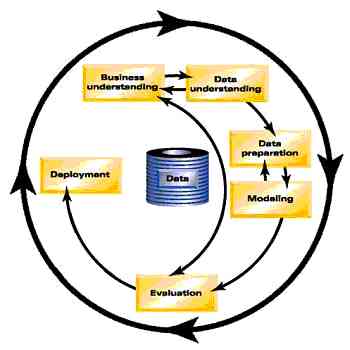
Product Demo: None
Yokohama, Japan
Call for presentations deadline: August 10, 2001
The Challenges Facing Data Resource Management
London, UK
Details: www.dama.org or contact davidab@compuserve.com
Location: Old Parliament House Canberra
Call for papers deadline: July 6, 2001
Details: www.dama.org.au/conference
Location: NIST, Gaithersburg, Maryland
Theme: Metatopia - The Best Data For All Possible Worlds
Program:
Keynotes by Jeff Tash and Michael Brackett
4 Tracks - including mini tutorials - with over 30 expert speakers
Exhibits on site
Fee: free to members, $10 for non-members (see membership fees & benefits)
Agenda:
| 8:30 | - | 9:00 a.m | - | Registration (breakfast goodies furnished by sponsor) | |
| 9:00 | - | 9:15 | - | Business Meeting | |
| 9:15 | - | 11:30 | - | Lectures and discussions | |
| 11:30 | - | Noon | - | Product demo by sponsor | |
| Noon | - | 1 p.m. | - | Lunch Join the speakers
for lunch at America Restaurant in Union Station. (see Menu with prices. Tax and tip will be paid by the meeting sponsor and DAMA-NCR.) |
Location: Room 2990, BLS (see Directions and Security Procedures)
Please note room change: Room 2990 is on the second floor and is known as the "old" Cognitive Lab. (The "new" cognitive lab is still under construction on the first floor). Room 2990 is in the NW corner of the Postal Square Building (home of the Bureau of Labor Statistics), across from Union Station. As usual, use the Visitor's Entrance on First Street, N.E., facing Union Station.
Topic 1: The Dotcom Data Architect
Speaker 1: Rajan Chandras, CSC Consulting (see his bio)
Abstract:
Many organizations and project teams fail to recognize that not having a
Data Architect on the team is a serious threat to the success of the
dot-com project; going further, they are even unaware of the exact nature
of the role of the Data Architect. Having a dba (database administrator) on
the project team is deemed sufficient from the 'data perspective', and this
short-sightedness can - and sometimes does - lead to project failure. Rajan
Chandras will discuss his perspective on why it is important to have a
designated and experienced Data Architect on dot-com projects. He will also
discuss the various responsibilities of the dot.com data architect, and
what distinguishes the role from various other project roles (such as the
dba).
Topic 2: Technical Case Study: Census 2000 Analysis & Dissemination
Speaker 2: Seth Grimes (see his bio)
Abstract:
Tabulating the 2000 US census involves computing thousands of aggregate measures over more than 10 million geographic areas to support congressional redistricting and hundreds of billions of dollars of federal and other government funding programs. Accuracy, flexibility, and security requirements are extreme, as is the need for excellent performance given a 400-million-record dataset and the requirement to produce numbers from both raw and statistically adjusted data that arises from the volatile mixture of survey miscount and political battling.
The US Census Bureau has a history of aggressively adopting innovative technology for census tabulation, from punch cards to the earliest digital computers. This round of the decennial census marks the first time that the analysis system has integrated a COTS package, the SuperSTAR suite from Space-Time Research, and featured Web dissemination of summary statistics, via the American FactFinder Web site.
Development-team lead Seth Grimes will describe the census tabulation problem and Census Bureau's innovative solution integrating the SuperCROSS analysis engine with SAS for data transformations and scripted interfaces that automate production processes. He will discuss the system architecture created to respond to functional requirements and "non-functional" properties and the development, test, and production practices that have both mitigated risk and led to very significant cost savings.
Location: BLS Conference Training Center (see Directions and Security Procedures)
Fee: member $30, non-member $60, book not included (see membership fees & benefits). Fee includes morning and afternoon snacks. Lunch available at BLS cafeteria and across the street in Union Station (restaurants and food courts)
Pre-registration: required.
- Call the DAMA-NCR Business Office at 301-843-2456 to reserve your space
Note: this is our new (temporary) phone number. You'll reach Jennifer McLellan, our office manager.- Payment methods: credit card, check, purchase order, or training form
- Please download the handouts before the seminar. Handouts will not be supplied at the seminar. PDF file, 265 KB. Download now.
Registration: 7:30 - 8:30 a.m. (Coffee, tea, bagels, & Danish)
Program: 8:30 a.m. till 4:30 p.m.
Instructor: Fabian Pascal (see his
bio)
?+
"
}Description:
A vast majority of practitioners are inducted into the database field-as DBAs, application developers, DBMS designers, managers, or users-by learning or working with some specific DBMS software such as Access, Oracle, or SQL Server. Yet even a cursory inspection of difficulties encountered in practice by novices or the technically proficient reveals that the problems:
a) are common to most, if not all database projects
b) recur over and over again
c) have costly consequences
d) correct solutions cannot, or will not, come from DBMS software, per se.Distinct from product-specific training prevalent in the industry, this seminar identifies two* core issues in database management -- "complex" data types/"unstructured" data and missing information -- that practitioners have recurring difficulties with. It demonstrates practical implications, provides the correct solutions, assesses whether and how well current DBMS products support these solutions and, if they do not, offers -- wherever possible -- workarounds.
The objective is to provide knowledge and skills essential for and applicable to all database projects, whether Web-based or not, regardless of the DBMS software used.
Upon completion of the course, participants should have the ability to:
- Understand central issues in database management and appreciate their practical implications
- Avoid costly misconceptions and fallacies prevalent in the database industry
- Understand the correct general solutions to core problems
- Assess whether and how well commercial DBMS software support such solutions
- Overcome, work around, or minimize the consequences, if and when products do not provide correct and satisfactory support
* Time permitting, a third issue -- redundancy -- will be covered.
Read a complete outline of his longer seminar, of which sections 1 and 10 will be covered, along with section 8 if time permits.
Fee: free to members, $10 for non-members (see membership fees & benefits)
Agenda:
| 8:30 | - | 9:00 a.m | - | Registration (breakfast goodies furnished by sponsor) | |
| 9:00 | - | 9:15 | - | Business Meeting | |
| 9:15 | - | 11:30 | - | Lectures and discussions | |
| 11:30 | - | Noon | - | Product demo by sponsor | |
| Noon | - | 1 p.m. | - | Lunch Join the speakers
for lunch at America Restaurant in Union Station. (see Menu with prices. Tax and tip will be paid by the meeting sponsor and DAMA-NCR.) Sponsor is Metagenix, Inc. |
Location: BLS Conference Training Center (see Directions and Security Procedures)
Business Meeting
Election of officers: President, Vice President for Programs, Vice President for Administration and Finance.
Topic 1: Information Architecture - Successes from the Data Architecture (see PowerPoint Slides)
Speakers : Ted Griffin (bio), Jason Kruse (bio), Lisa Black (bio), Connie Dowler (bio)
Abstract:
- Ted Griffin, Federal Lead, Strategic Planning & Architecture (SPA), Office of Science (SC), Department of Energy - Will talk briefly on his perception of life with an Information Architecture and the benefits overall. Will then introduce the following speakers.
- Jason Kruse, Contractor Lead, SPA - Will talk about the methodology and the implementation of the Enterprise Architecture process used and adaptations implemented over the annual updates. Will then introduce the following speaker.
- Lisa Black, Lead Analyst and Data Architect & Connie Dowler, Analyst and DBA, contractors for the Systems Development group, DOE SC. Will give the real world view from the trenches of the data architecture from the inception as a logical model from the EAP to rollout of a system that forces data validation at the client based on the database rules.
Topic 2: What's Wrong with the (Database) Picture?
Speaker: Fabian Pascal (see his bio)
Abstract:
Most of what is being said, written about, or done in database management (or whatever is left of it) by vendors, the trade press and "experts" is irrelevant, misleading, or outright wrong. While this is to a degree true of computing in general, in the database field the problems are so acute that, claims to the contrary notwithstanding, technology is actually regressing! This is due to the persistent failure by both DBMS vendors and database users, including DBAs, application developers and managers, to educate themselves and rely on a sound foundation in their respective practices. Indeed, it is lack of proper education that makes fads and accelerating obsolescence acceptable in the first place!
This presentation demonstrates the fundamentally flawed way in which the database industry operates and offers you an opportunity to test yourself on your ability to see through the prevalent industry fallacies and avoid their costly practical consequences of which you are probably not even aware in areas such as database design (normalization and "denormalization") and -- time permitting -- duplicates and keys.
Product Demo: Metagenix, Inc. ( www.metagenix.com )
Sponsor: DAMA North East (in cooperation with DAMA-NCR)
Location: Crystal City Hilton, Arlington, Virginia
Details: http://www.damane.org/
Highlights:
Bill Inmon, Father of Data Warehousing,
on FUTURE TRENDS AND DIRECTIONS IN DATA WAREHOUSINGNeil Raden, Director, Archer Decision Sciences , Leading Author, Lecturer and Consultant
on eBUSINESS INTELLIGENCE --- DELIVERING WITH YOUR DATA WAREHOUSESheila Jeffrey, Vice President, First Union, Charlotte, N
on MINING FOR CUSTOMER RELATIONSHIPS AT FIRST UNION --- THE BIGGEST DATA WAREHOUSE IN BANKINGAnne Marie Smith, Data Architect Consultant, Assistant Professor of MIS, LaSalle University
on BUILDING AND MANAGING YOUR METADATA REPOSITORY: KEY TO DATA WAREHOUSING SUCCESSArthur F. Chantker , President, Potomac Consortium will be the Moderator
will be held at the
Hilton Anaheim
Anaheim, California
$250 discount for DAMA members.
For more information email VP Conference Services, or visit these web sites: DAMA International or Wilshire Conferences.
Fee: free to members, $10 for non-members (see membership fees & benefits)
Agenda:
| 8:30 | - | 9:00 a.m | - | Registration (breakfast goodies furnished by sponsor) | |
| 9:00 | - | 9:15 | - | Business Meeting | |
| 9:15 | - | 11:30 | - | Lectures and discussions | |
| 11:30 | - | Noon | - | Product demo by sponsor | |
| Noon | - | 1 p.m. | - | Lunch Join the speakers
for lunch at America Restaurant in Union Station. (see Menu with prices. Tax and tip will be paid by the meeting sponsor and DAMA-NCR.) |
Location: BLS Conference Training Center (see Directions and Security Procedures)
Topic 1: Lessons Learned From Excellent Companies: the Baldrige Criteria for Performance Excellence, and the Role of Information and Analysis in an Organizational Performance Management System
Speaker: Dr. Harry Hertz, Director of the Baldrige National Quality Program (see his bio)
Abstract: (Download the presentation, 3.5 MB PowerPoint file. For more background information, see highlights of the National Quality Program web site.)
The Malcolm Baldrige Criteria for Performance Excellence provide a systems perspective to enterprise management and improvement. At the foundation of this system is Criteria Category 4 – Information and Analysis. The presentation will include a discussion of the organizational scope for information and analysis, and the use of information and analysis in serving internal customers, including senior leaders. Senior leaders need information and analysis to perform organizational performance reviews and identify opportunities for organizational improvement and change.
You will learn:
- How your organization can self-assess against Baldrige Criteria Category 4 – Information and Analysis.
- What we have learned from recent Baldrige Award applicants relative to organizational performance and the role of information and analysis.
- Future challenges facing U.S. organizations, including CEOs' perceptions of these challenges.
Topic 2: Practical Visual Modeling
Speaker 2: Robert A. Maksimchuk, Rational Software Corporation (see his bio)
Abstract: (Download the presentation, 2.0 MB zipped)
Project teams beginning to adopt modeling often suffer from the “white paper syndrome” – they’ve been trained but struggle with where to begin, how deep to go, etc. This presentation approaches visual modeling pragmatically. Basic visual modeling is discussed, augmented with practical, experiential advice from real world projects and heuristics for the beginning visual modeler.
Attendees will learn about:
Techniques to prepare and plan for your object-oriented project
Business modeling vs. System modeling via use cases
Avoiding common modeling pitfalls during analysis and design
Basic UML techniques
Product Demo: Rational Software Corporation
Location: BLS Conference Training Center (see Directions and Security Procedures)
Fee: member = $30, non-member = $50. (see membership
fees & benefits)
Special: Seminar plus membership for $75
Preregistration:
- Call the DAMA-NCR Business Office at (703) 442-8780
- Payment methods: credit card, check, purchase order, or training form
- Check back here for materials to download for the meeting
Registration: 8:00 - 9:00 a.m. (bagels, Danish, coffee & tea provided)
Program: 9:00 a.m. - 4:30 p.m. (see agenda below)
Speakers:
Ron Shelby, CEO, XMLSolutions (see his bio) (download his PowerPoint presentation, 1.6 MB)
Phil Teplitzky, CTO, Mibrary.com (see his bio)
Kevin Kail, President, XMLSolutions (see his bio)
Description:
Since the beginnings of technology, there have been many predictions about the limits of progress:
In the first century Roman engineer Sextus Julius thought the world had become so progressed that he actually said, "Inventions have reached their limit, and I see no hope of further development."
In 1899 the commissioner of the Patent Office of the United States suggested eliminating his department because "there couldn't possibly be anything left to invent."
In this one-day seminar we will ask
- Is E-Business really something new for the data world or is it just more of the same old stuff
- What old stuff is still important and perhaps made more important?
- What old stuff is no longer important, and perhaps irrelevant?
- What new stuff should we be concerned with?
- Where do data models, metadata, data quality fit (or do they fit)
- SGML, HTML, XML, ... - where are we going?
Program Agenda
8:00 - 9:00 AM : Breakfast
9:00 - 10:00 AM : Ron Shelby "E-Commerce Data Challenges at General Motors"
10:00 - 12:00 PM : Phil Teplitsky "B2C Case Study: Citibank"
Noon - 1:00 PM : Lunch
1:00 - 2:00 PM : Phil Teplitsky - finish the walk through case study of Citibank
2:00 - 4:00 PM : Kevin Kail "Data Requirements for B2B Today and Tomorrow"
Agenda:
| 8:30 | - | 9:00 a.m | - | Registration & breakfast goodies furnished by sponsor | |
| 9:00 | - | 9:15 | - | Business Meeting | |
| 9:15 | - | 11:30 | - | Lectures and discussions | |
| 11:30 | - | 1 p.m. | - | Join the speakers
for lunch at America Restaurant in Union Station. (see Menu with prices. Tax and tip will be paid by the meeting sponsor and DAMA-NCR.) |
Location: BLS Conference Training Center (see Directions and Security Procedures)
Speaker 1: Dr. Peter Aiken, author and Associate Professor of Information Systems, Virginia Commonwealth University See his bio. Please download his slides for the meeting! (pdf file, 900 KB)
Topic 1: Metadata Engineering for Corporate Portals Using XML (SPECIAL PRESENTATION)
Abstract: Careful analysis and preparation is required in order to prepare for XML-based delivery of data via Corporate Portals. This process is refereed to as Engineering Enterprise Portals. Two phases are required when engineering Enterprise Portals: metadata engineering and metadata implementation. This presentation describes the use of the metadata model to guide the metadata engineering as a precursor to metadata implementation in preparation for XML-based delivery. In metadata engineering, logical models representing the "as is" system data are developed by reverse engineering the data. Once derived this metadata is typically maintained using entity relationship diagrams. Metadata about entity relationship diagrams can be maintained with a many to many association between two metadata entities: LOGICAL DATA ENTITY and LOGICAL DATA ATTRIBUTE. The two metadata entities form the basis of a metadata model that can be used as a structure facilitating the subsequent metadata implementation. Understanding the requirements of metadata engineering is a necessary prerequisite to delivering data via Corporate Portals via XML.
Speaker 2: Dr. Aiken will continue his presentation in this slot.
Product Demo: none
Agenda:
| 8:30 | - | 9:00 a.m | - | Registration & breakfast goodies furnished by sponsor | |
| 9:00 | - | 9:15 | - | Business Meeting | |
| 9:15 | - | 11:30 | - | Lectures and discussions | |
| 11:30 | - | Noon | - | Product demo by sponsor | |
| Noon | - | 1 p.m. | - | Join the speakers for lunch at
America Restaurant in Union Station. (see Menu with prices. Tax and tip will be paid by the meeting sponsor and DAMA-NCR.) |
Location: BLS Conference Training Center (see Directions and Security Procedures)
Speaker 1: Scot A. Becker, Principal Consultant, InConcept, Inc.( http://www.inconcept.com ), and Editor, The Journal of Conceptual Modeling ( http://www.inconcept.com/JCM ) (see his bio )
Topic 1: Conceptual Data Modeling in an Object-Oriented Process (download the PowerPoint slides, 345 KB)
Abstract: (reference material is coming)
This presentation will detail what an object oriented (OO) process is and what the pros and cons of using an OO process are. Further, this presentation will introduce a more rigorous way to model data (namely, Object-Role Modeling or ORM) and the associated business rules and requirements, and how to incorporate that rigor into an OO process resulting in better quality of analysis and design artifacts for more accurate, robust, and precise software.
The attendee will learn
- What an OO process is; Pros/Cons of an OO Process
- What ORM is (briefly); Pros/Cons of ORM
- How to integrate ORM into an OO Process such that the two techniques work in tandem while emphasizing the strengths of each
- Case study illustration of the benefits of this approach
Speaker 2: John Bell from RWD Technologies (See his bio.)
Topic 2: Introduction to UML (download the PowerPoint slides, 265 KB)
Abstract:
This session provides an introduction to the Unified Modeling Language (UML). UML is the Object Management Groups (OMG) industry standard language for Object Modeling. UML supports Object Oriented Analysis, Design and Development. This topic would provide an overview of the diagrams and features supported by UML and how they are applied. By the end of the presentation the audience should be able to recognize and read basic UML diagrams and should have an understanding of how to apply the diagrams within the software development life cycle.
Product Demo: Informatica
Location: BLS Conference Training Center (see Directions and Security Procedures)
Fee: member $25, non-member $40 (see membership fees & benefits)
Preregistration: required. (CLOSED)
- Call the DAMA-NCR Business Office at (703) 442-8780 to reserve your space
- Payment methods: credit card, check, purchase order, or training form
Registration: 7:30 - 8:30 a.m.
Program: 8:30 a.m. till 4:30 p.m.
Instructor: Dr. Jerrold Rosenbaum, Concentrx, Inc ( see his bio )
Description:
This is a follow-on to our very successful Data Modeling 101 Class. It is the workshop that accompanies the class that Dr. Rosenbaum has been teaching to many companies since 1989. The exercise for the workshop takes the student from requirements through conceptual and logical design into the first cut physical database design.
Coarse Material: Must be downloaded from this web site. Get instructions when you call to register.
Note: DAMA NJ and Wilshire Conferences have donated a free registration for the ebusiness conference (9/18-9/20 in Atlantic City) to be offered as a door prize - worth $1095
Agenda:
| 8:30 | - | 9:00 a.m | - | Registration & breakfast goodies | |
| 9:00 | - | 9:15 | - | Business Meeting | |
| 9:15 | - | 11:30 | - | Lectures and discussions | |
| 11:30 | - | Noon | - | Product demo - None | |
| Noon | - | 1 p.m. | - | Join the speakers for lunch in
a Union Station restaurant. (Extra cost, to be announced, is being negotiated. Menu will be posted here and at meeting.) |
Location: BLS Conference Training Center (see Directions and Security Procedures)
Business Meeting Topic: Report on DAMA-I Projects by Twyla Courtot (see her bio)
Speaker 1: Cynthia Walker, President, WalkerBurr, Inc. (see her bio and her PowerPoint presentation 370 KB)
Topic 1: Data Management: Where we’ve been and where we’re headed
Abstract:
This presentation examines the important lessons we’ve learned over the past two decades managing corporate data and draws some interesting conclusions about how applicable these lessons will be for dealing with future challenges.
Speaker 2: Mike Douglass, Govt. Sales Manager, Sequoia Software Corporation (see his bio and his PowerPiont presentation 1.4 MB and the Maturing Web Infrastructure graphic & text from Microsoft (html, 100 KB)
Topic 2: Putting XML to work on portal-based business processes
Abstract:
For the enterprise seeking to exploit its intranet in support of critical business processes, XML will have significant implications. XML will have a dramatic impact on e-commerce, EDI, and data management strategies as well. The adoption of enterprise information portals is growing as an architectural alternative for information operations. Finally XML and portals have converged in a powerful way to support business process improvement. Sequoia's XML Portal Server (XPS) exploits the wide range of practical applications of XML in "programming the web" to get work done.
Product Demo: No product demo is scheduled for today's meeting.
Time: 8:30 a.m. - noon
Agenda:
| 8:30 | - | 9:00 a.m | - | Registration & breakfast goodies | |
| 9:00 | - | 9:30 | - | Annual Business Meeting | |
| 9:30 | - | noon | - | Lectures and discussions | |
| noon | - | 1 p.m. | - | Join speakers and your colleagues for lunch at the America restaurant in Union Station. (Sorry, NCR can only pay for the speakers' lunch) |
Location: BLS Conference Training Center (see Directions and Security Procedures)
Business Meeting
Elections: Nominations are open. Current candidates are:
VP for Programs (2 year term) - Tom McCullough
VP for Publicity (2 year term) - Rosie Field
VP for Membership (fill vacancy for 1 year of 2 year term) - Frank Jackson (acting)
VP for Administration and Finance (fill vacancy for 1 year of 2 year term) - noneProposed Bylaws Amendment: membership shall start at time of dues payment and shall last for increments of one year. This "floating dues payment" shall be applied to current members.
Discussion: Current bylaws specify that "the membership year shall begin on October 1 and end on September 30". The proposal will remove ambiguities in the amount due when dues are paid in mid year. Administrative tasks will be easier to perform.
Report from DAMA International Liaison - Twyla Courtot
Speaker 0: Rod Morgan (10 min.)
With the CIO Council taking a more active role in Executive Branch data management, it can be useful for decisions reached by Federal chief information officers to be shared. Rod Morgan, Branch Chief for Data Administration, will provide a short explanation of a recent policy statement in the Department of State "Foreign Affairs Manual" that very positively places Data Administration in a key development role. Beyond its obvious impact for State, the document can be a starting point for discussion and policies in other environments.
Speaker 1: Micael M. Gorman (see Mike's bio and also his slides)
Topic 1: SQL:1999 and its impact on database design, data administration, database administration, and database application development.
Abstract:
From 1986 through 1999, ANSI SQL standards have been based on two-dimensional tables. This made SQL's data model relational, in the main. SQL:1999 the new ANSI database languages standard has dramatically broken from the relational model and has specified complex, nested data structures, its own programming language, Spatial and Full Text processing facilities, and even Codasyl sets. The purpose of this talk is to review these "new" facilities and to identify the impact they will have on database design, data administration, database administration, and database application development. Finally the talk presents the results of an informal survey among the key vendors as to their SQL:1999 implementation directions.
Speaker 2: Les LaJoie (See Les' bio)
Topic 2: A Blueprint for Data Warehousing
Abstract:
Almost anyone can build a data warehouse. However, designing, building, and maintaining a data warehouse that works is harder. This talk addresses some important factors, including factors that may appear to be a small detail, that help lead to sucess.
For all presentation summaries, photos, presentation slides missing from the conference CD, and other highlights, see http://www.dama.org/Symposium2000.htm and the Wilshire Conferences website.
Location: Hyatt Regency Crystal City - Arlington, Virginia
The DAMA-NCR chapter had the task of planning the program for the DAMA half of this joint event. DAMA-NCR's Program Committee selected 30 of the best of over 100 abstracts submitted for the DAMA Symposium.
6 tracks with over 60 speakers
Plus 6 full day tutorials
And 2 workshopsKeynotes by Doug Hackney, Graeme Simsion
Presenters included:
Larry English
Bill Smith
Claudia Imhoff
Barbara von Halle
John Zachman
Graeme Simsion
Mike Brackett
Bernie Boar
Peter Aiken
Clive Finkelstein
Dave Hay
John Sharp
Terry Halpin
Time: 8:30 - 9:00 a.m. - Registration
& breakfast goodies
9:00 - noon
- Lectures and discussions
Location: BLS Conference Training Center (see Directions and Security Procedures)
Special prizes: DAMA polo shirts and one of Ron Ross' books (random drawings based on sign-in sheet)
Speaker 1: Dr. John Friedrich, Project Manager, Health Information Resources Service (see John's bio)
Topic 1: Justifying Data Administration and Metadata Management
Abstract:
In January 1996, the MHS Proponent Committee granted Executive Agency status to the Air Force for the Health Information Resources Service (HIRS). In performing its charter, the HIRS team provides and maintains an Operational Central Repository of integrated systems-related information needed by MHS, AFMS, and other government agencies (partners) for both functional and technical activities, including data administration, infrastructure modernization, and application development and integration. HIRS has gone beyond this role, however, emphasizing real solutions for real return on investment for the customers of the Data Administration Community. In fact this emphasis has led to HIRS approaching Data Administration (DA) activities from a Business Plan-like approach.
As with all Business Plans, the customer comes first. In this case, the customers are the users of Automated Information Systems (AIS’s). They drive the effort to develop systems and define by their needs the functional requirements (FR’s) that those systems support. Formal efforts of Business Process Improvement (BPI) are also conducted to ensure improvement and consistency with need and vision. It is important to note that while DA support tools, standards, policy and guidance, and configuration management ensure compliance by programs, they do nothing to make programs capable of providing real return on investment for their customers, the real customers, i.e., functional users. This area is where tools to support developers in developing systems that do inter-operate and prototypes of such systems become so valuable. HIRS has several success stories of application of these capabilities to provide RoI.
(You can get information on HIRS at http://www.hirs.osd.mil )
Speaker 2: Bob Coen (substitution for Les LaJoie)
Topic 2:
Abstract:
We have arranged a special program featuring Graeme Simsion and Tom Finneran. (Graeme is the popular keynote speaker in the May 1999 DAMA International program. He will be traveling from Australia on an extended speaking tour, covering 13 DAMA chapters in US and Canada.)
Time: 8:30 - 9:00 a.m. - Registration
9:00 - noon
- Lectures and discussions
Location: BLS Conference Training Center (see Directions and Security Procedures)
Speaker 1: Graeme Simsion, Managing Director of Simsion, Bowles and Associates (see Graeme's bio)
Topic 1: Data Modeling - Testing the Foundations
Abstract:
This presentation and another presentation are available on Simsion's web site at http://www.sba.com.au/home.htm Click on the action gif about his US DAMA Tour 2000. pdf and zipped pdf available))
Graeme's article with this title in Database Programming and Design (Feb 1996) discussed some fundamental issues in data modeling - relevant to novices and experts alike. It attracted a record number of letters, most of them about his contention that "data modeling is a design discipline". This is also the theme of his widely-used book Data Modelling Essentials - Analysis, Design and Innovation.
Graeme will raise some of the most contentious issues in data modeling - issues in which he has previously found both academics and practitioners prepared to argue passionately for one side or the other.
Speaker 2: Thomas R Finneran, a Principal Consultant at the CIBER Custom Solutions Group (see Tom's bio)
Topic 2: Component-based Architecture - A New Information/Knowledge Management Adventure
Abstract:
check back here, before 1/15/00, for the slide presentation
A Component-based Architecture uses components to define information, business, application, and technology architectures. Components encourage reuse, help move from application silos, are being used by leading application vendors, and give us a vehicle to really use Business Rules.
We will review the following component models:
We will discuss how component architecture relates to thinking like that of John Zachman and Larry English.
Finally we will discuss real-life situations and opportunities for Component Architecture including Component Metadata, Enterprise Architecture, Legacy System Interfaces, Informational Data (Data Warehouse) Solution Design, and Component Information/Knowledge Quality Administration and Stewardship.
The presentation outline includes:
Data Modeling 101
Note: this is a repeat of the very popular course we gave last summer. The ratings from all 65 attendees were outstanding. We'll limit attendance to 45 so sign up early.
Location: BLS Conference Training Center (see Directions and Security Procedures)
Fee: member $20, non-member $30 (see membership fees & benefits)
Call the Business Office at (703) 442-8780 to RSVP and for payment
arrangements (checks, purchase orders, and training forms accepted).
Registration: 7:30 - 8:30 a.m.
Program: 8:30 a.m. till 4:30 p.m.
Instructor: Dr. Jerrold Rosenbaum, Butler Technology Solutions, Inc speaker biography
Description:
This tutorial will provide an introduction to data modeling. The course originated as the Codd & Date course on Conceptual and Logical Data Modeling. The course is applicable to building enterprise data models as well as application data models, data warehousing and data marts. Dr. Rosenbaum has been teaching this class to many companies since 1989. He will be teaching a one day version of this course.
The course will include
- Business Context for Data Modeling
- Zachman Framework
- Getting Started (where to find starter models)
- Conceptual (or Business) Data Modeling
- Logical Data Modeling
Time: 8:30 - 9:30 a.m. - Registration
9:30 - noon
- Lectures and discussions
Location: Bureau of Labor Statistitics, see Time, Place, Directions, and Security Procedures for all regular meetings.
Topic 1: Data Migration - Keys to Sucess Across the Enterprise
Speaker: Aaron Schapiro, Evoke Software, Inc
Speaker: Terry Quatrani, Rational Software Corporation (See Terry's biography sketch
Abstract:
One of the most difficult areas of application development is mapping that application to the database which it relies on to get its data. In this session we will introduce the UML notation, discuss some of the techniques for object/relational mapping and see how the UML will open communication between the application, business and database centric development teams.
Bonus Topic (20 minutes): The Ultimate Web: a Super-Web Data Model, new XML Technologies, and their Implications to Data Managers
Speaker: Jim Carpenter, Bureau of Labor Statistics (see Jim's biography sketch)
Abstract: (click here for his slides and reference material.)
The Ultimate Web includes what Tim Berners-Lee, the inventor of the World Wide Web, calls the "semantic web", meaning the "web of meaning". Other ways of viewing the semantic web are as a web of models, a web of languages, or a web of schemata. The underlying ideas are so simple yet so powerful, like email or web pages. The semantic web will allow working on the web to be so much more productive.
Jim has developed a data model (in UML) of a generalized web, a super-web. The WWW, the semantic web, and many other webs are special cases. Jim uses this model to motivate and frame the recent work of OMG’s MOF Working Group and the ISO L8 (Metadata) Working Group. He suggests what data managers can do to prepare for the semantic web revolution.
Note: The fee for this event is Members $45; Nonmembers $60 . We kept it as small as possible. Ron is a noted author and popular speaker, so please register early. Free copies of his books will be raffled. (Ron will be making presentations to the New York and Chicago chapters of DAMA following this event in Washington, DC.)
To register: Call DAMA-NCR business office at 703-442-8780 to RSVP and for payment arrangements (checks, purchase orders, and training forms are accepted.)
Time: 8:30 a.m. - Noon
(registration starts at 7:30 a.m. with complementary coffee, bagels, & Danish)
Ronald G. Ross, see his biography
sketch
Principal, Business Rule Solutions, Inc.
Location: Bureau of Labor Statistics (see Directions and Security Procedures)
Abstract: (See litterature & web references, including a summary slide presentation in PowerPoint)
IT managers and professionals have a front-line view of their company's headlong assault on the information age. Prepared or not, their companies are plunging ahead. The obstacles to success are numerous. There seems to be no common thread to all the challenges. On the IT side are the problems of re-usability and flexibility. The Internet holds new threats and opportunities. In project management, the business/IT gap remains. On the business side, managers are struggling to find workable ways to manage knowledge.
Is there any common factor? Yes - business rules! In this presentation, Mr. Ross explains what business rules are about, and how they address the many challenges your company faces today.
In cooperation with DAMANE (see http://www.damane.org/DWConf.htm )
Location: KEY BRIDGE MARRIOTT, Arlington, Virginia
Time: 9:00 AM - 5:15 PM (Registration 8 to 9 AM)
Featuring RALPH KIMBALL: THE FOUNDER OF STAR SCHEM
Moderated by: Art Chantker, Director of AFFIRM, President, Potomac Forum
Keynote Presentations:
*** Attendance Includes ***
INFORMATION: Inquiries / Phone Registration (516) 221-5560
or email query to: Registration@damane.org =
ON-LINE REGISTRATION: Go to Website http://www.damane.org/DWConf.htm
OTHER METHODS: Fax This Notice to DAMA FAXLINE (516) 271-4129
or email to: Registration@damane.org
We will email you (or fax you) Registration Form== Please Enroll Early - There is Limited Space Available on Site ==
== This Event Will Sell Out Quickly ==
CONFERENCE FEES:
(_) Registration $250 Per Person (_) Discounted $225 (DAMA-NCR Members)
(_) VENDOR EXHIBIT / SPEAKER Call (516) 221-5560
First Regular Meeting of 1999/2000 program year
Time, Place, Directions, and Security Procedures for all regular meetings.We'll have a break with refreshments. You are welcome to join the speakers and DAMA-NCR officers for lunch at a restaurant across the street in Union Station.
Introductions & Welcome by Jim Carpenter & Jerry Rosenbaum.
Theme: Perspectives on Data Quality
Topic 1: Steps to Better Data Quality
Speaker: Ron Forino, DMR Consulting Group . See his biographical sketch. and his slides
Abstract:
What is Data Quality anyway? Some think it is data stewardship. Vendors describe it in terms of name and address cleansing. Most of us recognize flawed data, but would you recognize good data quality if you saw it? Surveys reveal that data quality is a leading contributor to Data Warehouse time and cost overruns. But what can an organization do to deal with poor data quality? Are there tools that can help?
This discussion describes the competencies associated with Data Quality. Through services provided by Data Management, data quality issues can be identified and addressed in the appropriate way and at the appropriate place in the organization. This discussion provides proven techniques and strategies for assessing data quality. It goes on to discuss where and how different types of data anomalies should be addressed in the organization and why.
Whether your data quality initiative is to launch an enterprise data quality program or to address the data quality associated with a data migration effort, you should know the strategy and tactics necessary to:
- Determine the scope of your data quality initiative,
- identify and measure the quality of the data,
- report anomalies to users and management,
- use and create quality Meta Data, and
- determine how, where and by whom data anomalies need to be addressed.
Topic 2: Feed Your Data Warehouse Quality Data
Speaker: Elaine Stricklett, Acton Burnell, Inc. See her biographical sketch. and her slides
Abstract:
Most of our data warehouses will have to incorporate data from many of our existing systems. We are aware that we need to "cleanse" the data that will feed our data warehouses, but many companies are overwhelmed by the enormity of the task. In addition, some may not be sure where to start. The problems encountered with the quality of the data can range from the simple to the complex and may include such things as differences in field length, data type, homonyms, synonyms, violations of business rules, invalid date dependencies, erroneous calculations, etc. In this presentation, I will demonstrate a systematic process for identifying existing data problems, prioritizing them, and ensuring that your data warehouse receives only the data that has been cleansed.
Data quality addresses the essential character of raw data in an organization's information systems and how well they comply with that organization's business rules. This compliance is measured by the accuracy, completeness, consistency, structural integrity, and business rules describing the data. The quality of an organization's data, then, determines its ability to convert its data into useful and reliable information for reporting or for decision making.
Examples:
- Navy reports differ on the number of submarines used in the Gulf War because they did not use common data elements (Source: Information Week, April 25, 1994).
- The most celebrated data quality problem is Year 2000. The Gartner Group estimates costs between $400-600 billion. Capers Jones estimates the costs at $1.5 trillion (including lawsuits).
- 40 - 60 % of expenses for service organizations are attributable to poor data quality (Source: Thomas Redman, 1998).
- 96,000 IRS refund checks were returned as 'undeliverable' due to bad addresses in 1992 (Source: Larry English, 1998).
- The U.S. Attorney General's office has stated that 'approximately $23 billion, or 14 percent of the health care dollar, is wasted in fraud or inaccurate billing' (source: Nashville Business Journal, September 1997).
- Oxford Health Plans, Inc. reported a fourth-quarter 1997 loss of $120 million. Cited primary reason was poor data quality.
Many organizations have data that is between 5% and 10% defective (Source: Dr. Robb Wilmot, Fujitsu Personal Systems). Even a small percentage of poor quality data can cost an organization a great deal of money in rework, in decision support, customer service, and lost opportunities - or, in the case of a military organization - worse. Likewise, a data quality improvement of only a few percentage points can have a marked impact on earnings and or cost savings.
Data Modeling 101
Location: BLS Conference Training Center (see Directions and Security Procedures)
Fee: member $15, non-member $30 (see membership fees & benefits)
Call the Business Office at (703) 442-8780 to RSVP and for payment arrangements
(checks, purchase orders, and training forms accepted).
Registration: 7:30 - 8:30 a.m.
Program: 8:30 a.m. till 4:30 p.m.
Instructor: Dr. Jerrold Rosenbaum, Butler Technology Solutions, Inc speaker biography
Description:
This tutorial will provide an introduction to data modeling. The course originated as the Codd & Date course on Conceptual and Logical Data Modeling. The course is applicable to building enterprise data models as well as application data models, data warehousing and data marts. Dr. Rosenbaum has been teaching this class to many companies since 1989. He will be teaching a one day version of this course.
The course will include
- Business Context for Data Modeling
- Zachman Framework
- Getting Started (where to find starter models)
- Conceptual (or Business) Data Modeling
- Logical Data Modeling
Validating Information Models
Location: BLS Conference Training Center (Directions and Security Procedures)
Fee: Non-member $85, Member $50 (see membership fees & benefits)
Registration: 7:30 - 8:30 a.m.
Program: 8:30 a.m. till noonChairperson: Jerrold Rosenbaum, Butler Technology Solutions, Inc speaker biography
Introduction: Jim Carpenter, BLS and President, DAMA-NCR, speaker biography, literature references
Abstract:The introduction will discuss the historical, business, and technology context of this new and promising methodology and comment on its potential strengths and possible shortcomings.
Speaker: John Sharp, Sharp Informatics, Inc. speaker biography, literature references
Abstract:Natural Language Modeling (NLM) addresses the communication problem between the subject matter expert who has the problem and the analyst who is suppose to solve the problem. NLM is a procedure that defines sets of questions that are asked about simple sentences.
The analysis starts with a true instance sentence supplied by a subject matter expert or extracted from an existing information model. The initial sentence can be imperfect, inconsistent, or ill formed. The analysis is performed using specified steps defined in the NLM procedure. Depending upon the subject matter expert's answer(s) to the question(s), the procedure specifies which question(s) are to be asked next. The NLM procedure leads to the specification of all of the fact types contained in each instance sentence. All rules that apply to any sentence are established through the application of the NLM procedure. The resulting set of requirements does not depend on the past experience of the analyst, although, as in every expert endeavor, expertise and skill improves performance (both increasing speed and decreasing errors).
NLM specifies a procedure for doing analysis. It is not a set or rules for the presentation of analysis results. The function of NLM is to create a precise set of application requirements that is correct the first time. The NLM procedure allows subject matter experts to become accountable for establishing information system requirements, not information system analysts. The graphical presentation of the resulting knowledge (the validated model) can be presented in a suitable object-oriented or relational scheme. Having a precise model and having someone who is accountable for the knowledge content of the model allows for "real" engineering opportunities in the information technology arena.
You are cordially invited to attend a memorable reception and wine tasting
"A Bacchanalian History of Wine Seen Through 4,000 Years of Art"
at the Embassy of France, La Maison Franaise
4101 Reservoir Road, N.W
Washington, D.C.
Friday, May 14, 1999, from 7:00-9:30 p.m.
This multi-faceted event, co-sponsored by DAMA-NCR, and the Wharton, Penn, Harvard and Yale Clubs and the Allegro Society of the Alexandria Symphony, has many facets that will appeal to bon vivants through the D.C. area. It features a catered reception where you can network with members of the other groups, tastings of select wines from California's award-winning Clos P³gase winery, and a witty, illustrated commentary by winemaker Jan Shrem that has received rave reviews throughout the U.S.
A fascinating raconteur who founded Clos P³gase after achieving success in publishing, Mr. Shrem addresses these and other fascinating aspects of the world of wine: Where and when was the grape "born?" Which woman is believed to have discovered wine? Who was Bacchus before he was promoted to god of wine? What aromatic compound in wine stimulates the libido?
In commenting on these topics and more, Mr. Shrem will illustrate his points with over 100 wine-related pictures from the varied worlds of health, mythology, religion, history and love, among others. Mr. Shrem uses beautiful images of art works from such masters as da Vinci, Rembrandt, Dali, Picasso and Chagall to show the homage great artists have rendered to wine.
Times: 7:00 p.m., reception; 7:45 p.m., presentation in the theater
8:30 p.m., continuation of reception, Embassy ballroom
Tickets:
Before May 11: $45 for members and guests; $50 for non-members.
Contact DAMA-NCR business office at 703-442-8780 or email aiboss@aol.com
After May 11: $55
Note: This event will sell-out quickly, and each co-sponsoring group will only receive a limited number of tickets, so sign up promptly for this delightful evening.
Parking: Free, on-street or in the French Embassy garage.
Sponsored by Georgetown Art Guild and Clos P³gase Winery
Note: this is the last regular meeting of the 1998/99 program year (Sept-May). Special events are being planned for this summer.
Time, Place, Directions, and Security Procedures for all regular meetings.
Introductions: the New DAMA-NCR and Some Context for the Presentations
Speaker: Jim Carpenter, BLS, and President, DAMA-NCR, speaker biography, literature references
Abstract:DAMA-NCR went through a radical metamorphosis this spring. Jim will describe the highlights and how they can affect you.
How are today's topics related? Why should you care about the relationships? Jim presents a quick overview of a cool framework, which is a hot topic in the (government) CIO Council's architecture working group and elsewhere among a variety of types of "knowledge management professionals". He then captures the basic meta-attributes of each of today's topics. (That's tech talk for key points to look for.)
Topic 1: Metadata Registry Standards: A Key to Information Integration
Speaker: Judith Newton, NIST , speaker biography, literature references
Abstract:Metadata registries promote information exchange by providing an easily-accessed forum for display of standard data descriptions. Several standards address the semantics of registries to assist users in formulating consistent and precise metadata. These standards include:
- ISO/IEC International Standard 11179, Information technology - Specification and standardization of data elements, a six-part standard which contains:
- a Framework for the model of data management addressed by the standard;
- Classification, describing metadata structures;
- Basic Attributes of metadata elements;
- Standard Definitions for metadata;
- Naming and Identification of metadata;
- and Registration, guidelines for building and maintaining registries.
- ANSI X3.285, "Metamodel for the Management of Shareable Data" presents a model of metadata components and relationships. Proposed new work items will focus on further semantic issues of registry content and IT enablement.
This talk will describe these standards and several of their implementations, both in development and production. The benefits of data sharing and information exchange through common metadata cannot be overstated.
What the attendee will learn:
- Important standards assist in metadata development
- How WWW-enabled, publicly-accessible implementations of these standards promote understanding of the importance of data registration
- Metadata registries enable data sharing and reuse
Topic 2: An Overview of SQL Programmer
Speaker: Hal Williford, FDIC, speaker biography, literature references
Abstract:SQL-Programmer is an integrated development environment designed to assist database application developers with the construction and maintenance of server-side SQL code, such as stored procedures, functions, triggers and packages for Oracle, Microsoft, and Sybase servers. Its intuitive User Interface allows programmers to create multiple Personal Working Folders to quickly store and efficiently access all the information on a particular project.
SQL-Programmer's drag-and-drop Virtual Editor enables users to revise, maintain and test server-side SQL code without affecting the original source code on the database server. Plus, the Documentation Generator automatically documents the programmer's work, producing more than 60 comprehensive reports detailing their database server environment. SQL-Programmer also includes direct interfaces to Microsoft's SourceSafe, INTERSOLV PVCS, and MKS Source Integrity for Change Management
see www.dama.org